
A carton that looks right on the plant floor can become an expensive problem after it enters the distribution cycle. The decision between singlewall versus doublewall corrugated packaging affects product damage, line performance, warehouse space, freight weight, and total cost per shipment. The stronger board is not automatically the better buy. The right choice is the one that protects the product through its actual handling conditions without adding unnecessary material and transportation cost.
For manufacturers, food producers, distributors, and industrial operations, corrugated selection should start with the product and shipping environment, not simply the box size. A practical packaging review can identify where a singlewall carton is sufficient, where doublewall is necessary, and where a better design may reduce cost without sacrificing protection.
Singlewall Versus Doublewall Construction
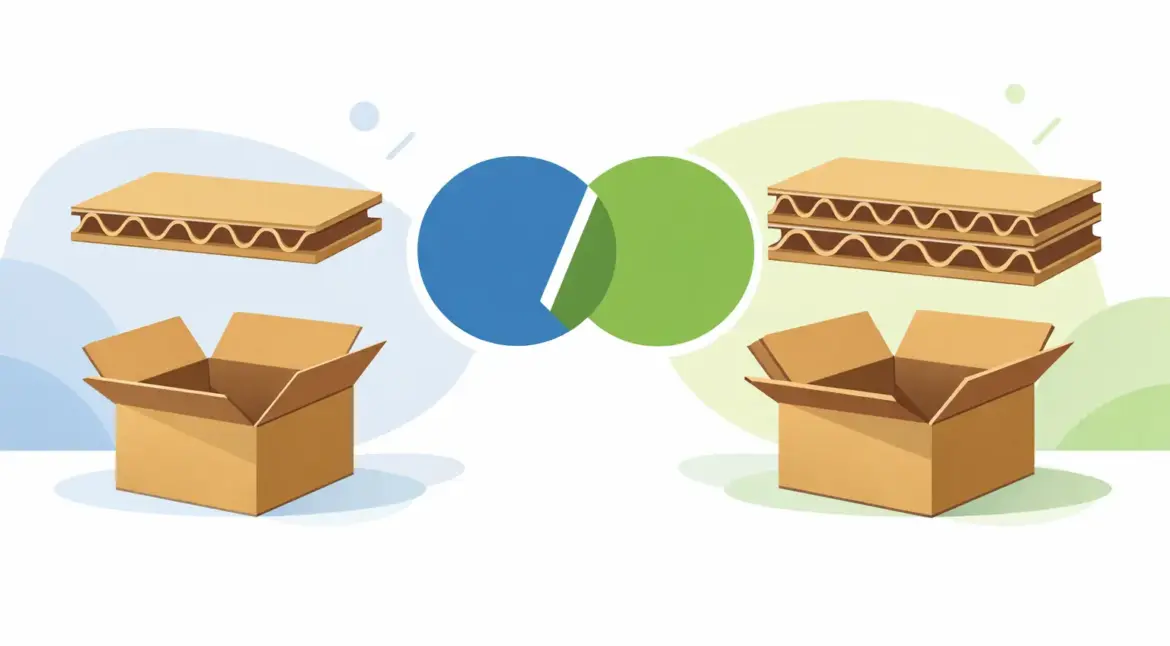
Singlewall corrugated board is made with one fluted medium bonded between two linerboards. It is the most common corrugated construction for shipping cartons, retail-ready packaging, die-cut boxes, pads, and many everyday distribution applications. It offers a useful balance of stiffness, printability, weight, and cost.
Doublewall corrugated board uses two fluted mediums and three linerboards. That added structure increases thickness, stacking strength, puncture resistance, and protection against the compression forces cartons experience in storage and transit. Common doublewall combinations include BC, EB, and AC flute profiles, with each option creating a different balance of cushioning, compression strength, and board thickness.
The difference is not just the number of layers. Board performance also depends on flute type, liner weights, paper quality, carton dimensions, manufacturer specifications, humidity exposure, box style, and how the load is packed. Two cartons described as doublewall can perform very differently in the field.
When Singlewall Corrugated Is the Better Business Choice
Singlewall is often the right answer for products that are relatively light, consistently packed, and shipped through controlled distribution channels. It works well when carton contents provide some internal support, pallet loads are properly configured, and the packaging will not face excessive stacking heights or repeated rough handling.
Many food, bakery, consumer goods, and light industrial applications can use singlewall successfully. It is especially effective for short-to-medium distribution cycles where cartons move from plant to warehouse to customer without prolonged storage or complex transfer points.
The operational advantage is efficiency. Singlewall cartons generally use less fiber, weigh less, occupy less storage space, and are easier to handle on high-speed packing lines. Those factors can lower packaging spend and freight cost at scale. A small reduction in carton weight or cube may not seem significant on one shipment, but it becomes meaningful across thousands of units.
Singlewall also gives packaging teams flexibility. The proper flute profile and liner combination can produce a strong, clean-running carton without defaulting to a heavier board grade. For example, a well-designed singlewall regular slotted carton with the right dimensions, tape pattern, and interior fit may outperform an oversized carton made from heavier material.
That said, material savings only count when performance is maintained. If a lighter board leads to crushed corners, popped manufacturer joints, damaged product, or customer complaints, the initial savings disappear quickly.
When Doublewall Earns Its Cost
Doublewall corrugated is built for more demanding conditions. It is often appropriate for heavy products, dense parts, bulk-pack applications, long-distance shipping, export loads, and cartons that will be stacked high in a warehouse or trailer. It can also be a smart choice for awkward products that create concentrated pressure points against the box walls.
Industrial components, metal parts, large packaged goods, glass-containing products, bagged materials, and multi-unit shipments are common candidates. So are products shipped through less predictable handling environments, including multiple cross-docks, mixed freight networks, and extended storage periods.
The added board structure helps cartons resist compression. This matters when a palletized load sits under other pallets, when trailers are tightly loaded, or when cartons spend time in humid environments. Corrugated loses strength as moisture increases, so a box that performs well in a dry test environment may not deliver the same result in a refrigerated, humid, or seasonal shipping condition.
Doublewall can also reduce the need for secondary protective materials. In some applications, a stronger outer carton allows a business to simplify partitions, pads, or void fill. That does not mean doublewall should replace thoughtful interior design. It means the outer container and internal packaging should be engineered together rather than sourced as separate decisions.
Compare Total Cost, Not Carton Price
Procurement teams understandably focus on the unit price of the box. But the lower-priced carton is not always the lower-cost packaging solution. A better comparison includes the costs that occur after the carton leaves the supplier.
Consider the full operating picture: material cost, pack-out speed, warehouse cube, pallet pattern, freight weight, damage claims, rework, labor, and customer experience. A doublewall carton may cost more per unit but reduce failures in a high-risk distribution channel. Conversely, using doublewall for every SKU can tie up cash in packaging inventory, increase freight spend, and add unnecessary material to products that do not need it.
Carton size deserves the same scrutiny as board grade. Oversized boxes waste cube and invite product movement. Undersized boxes can bulge, create sealing problems, and lose compression performance. A right-sized carton with appropriate internal protection is usually more valuable than simply moving from singlewall to doublewall.
Use Performance Requirements to Select Board
Start the specification process by documenting what the carton must endure. Product weight is essential, but it is only one variable. A 30-pound product that is compact and evenly supported behaves differently from a 30-pound product with sharp edges, an irregular shape, or a high center of gravity.
Review the shipping path from production through final delivery. How many times will the carton be handled? Will it move parcel, LTL, dedicated truckload, or export freight? Will pallets be double stacked? Is the product stored in a freezer, cooler, humid facility, or non-climate-controlled warehouse? Will the carton be reused or opened and closed during fulfillment?
Then evaluate measurable board and box requirements. Edge crush test, or ECT, is widely used to indicate the stacking strength potential of corrugated board. Mullen burst testing measures resistance to rupture under pressure. Neither number tells the entire story on its own. Box dimensions, flute direction, closure method, pallet loading, and distribution conditions all affect real-world performance.
A packaging engineer can help translate those conditions into a practical specification. The goal is not to buy the highest test grade available. The goal is to establish a board grade and carton design that consistently meets the job requirements.
Packaging Design Can Change the Answer
The singlewall versus doublewall decision is often treated as a simple material choice. In practice, design improvements may change the answer entirely. Adding partitions can stabilize multiple products. A corrugated pad can improve load distribution. A die-cut insert can protect vulnerable areas. A better flap configuration can improve closure strength and make the carton easier for operators to pack.
For palletized shipments, a revised footprint may improve pallet utilization and reduce overhang. Better load alignment can prevent edge damage and improve stacking performance without upgrading every carton. For fragile or high-value goods, testing the product, interior protection, carton, and pallet as one system is more reliable than evaluating each component in isolation.
This is where an integrated packaging partner adds value. TEC Business Solutions helps businesses look beyond a box quote by connecting package engineering, sourcing, inventory support, and freight coordination. That broader view can expose costs that are otherwise hidden between the production line and final delivery.
Avoid the Most Common Selection Mistakes
One common mistake is choosing board grade based solely on product weight. Weight matters, but distribution hazards and load geometry matter just as much. Another is using a generic specification across products with different dimensions, handling needs, and shipping channels.
Businesses also lose money by reacting only after damage occurs. Damage data should trigger a review of carton condition, load configuration, internal protection, moisture exposure, and freight handling. Replacing a singlewall carton with doublewall may solve the issue, but it may also mask a pallet, pack-out, or closure problem.
The opposite problem is over-specification. If a carton is consistently arriving in excellent condition with excess board strength, there may be an opportunity to reduce material, improve cube, or consolidate packaging SKUs. Time is money, and packaging that is heavier than necessary can slow operations and increase cost at every stage.
Make the Choice Around the Distribution Reality
Singlewall is often the efficient choice for lighter, stable products moving through predictable channels. Doublewall is often the safer choice for heavy, fragile, high-value, long-distance, or heavily stacked loads. Between those two positions is where most packaging decisions live: in the details of the product, the pack-out, and the supply chain.
Before changing a board grade, put the actual shipment conditions on the table. A carton that protects the product, runs efficiently, uses warehouse space wisely, and arrives consistently is doing more than containing a product. It is helping the operation move with fewer interruptions and fewer avoidable costs.