
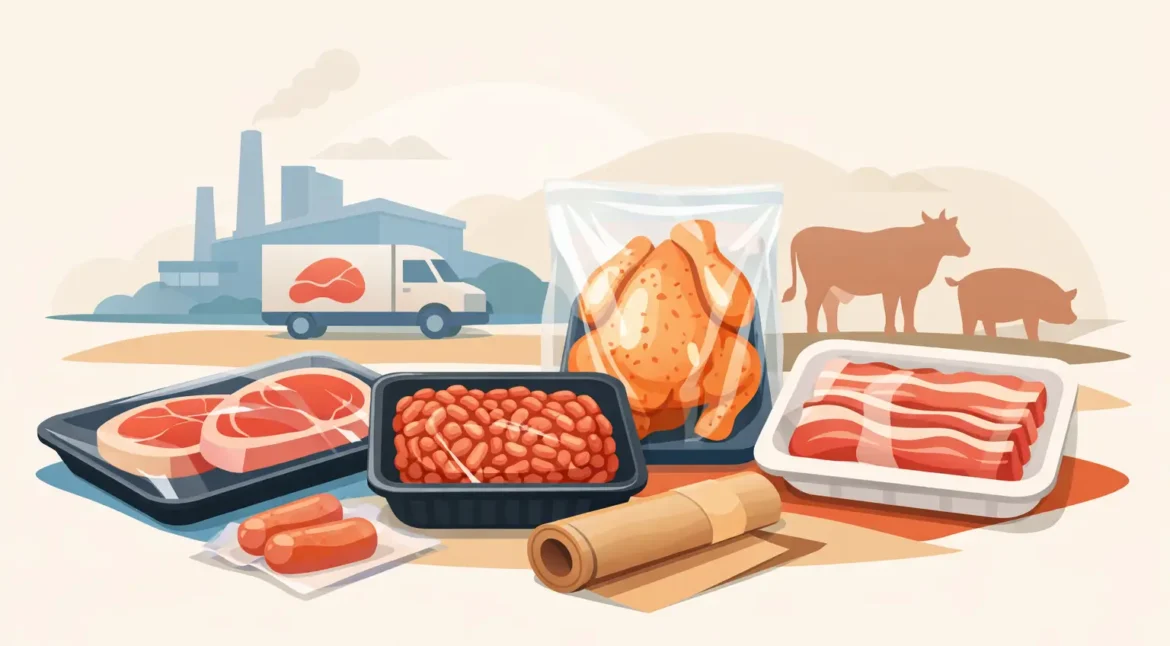
A leaking case, crushed carton, or box that fails after a few hours in a wet cooler creates more than a cleanup problem. It can lead to rejected loads, product loss, labor delays, and an avoidable hit to customer confidence. The best packaging options for meat protect the product through processing, cold storage, freight handling, and final delivery while helping the operation control total cost.
For meat producers, the right answer is rarely one material or one box style. It is a packaging system. Primary packaging preserves the meat. Secondary packaging groups and protects individual units. The outer shipping container has to perform in refrigerated and wet environments, stack efficiently, and arrive in usable condition. When those components are matched to the product and distribution process, packaging supports production speed instead of creating another point of failure.
Start with the product and distribution conditions
Meat packaging should be selected based on what the product experiences, not just the dimensions of the pack. Fresh cuts, ground meat, frozen proteins, poultry, and value-added products all place different demands on packaging. A fresh retail tray headed to a local distribution center has a different risk profile than frozen beef moving across several states on mixed pallets.
Begin with product weight, pack count, moisture exposure, storage temperature, expected shelf life, pallet pattern, and delivery distance. Also consider how many times the case will be touched. Cases that move from the packing line to a cooler, then to a distributor, retailer, and store back room need more compression strength than product moving in a short, controlled loop.
Time is money on a production floor. A case design that is difficult to erect, inconsistent in size, or prone to jamming can slow the line even when its purchase price looks attractive. The best choice is the one that protects the product and supports the full operating process at the lowest practical total cost.
The best packaging options for meat by application
Vacuum-sealed packages for extended freshness
Vacuum packaging removes air from around the product and seals it in a high-barrier pouch or bag. It is commonly used for primal cuts, portioned meat, marinated products, and products requiring extended refrigerated shelf life. The tight fit helps reduce freezer burn and limits product movement during shipping.
The trade-off is presentation and handling. Vacuum-packed fresh meat can have a darker appearance until the package is opened and exposed to oxygen. Puncture resistance also matters. Sharp bone edges, heavy products, and aggressive case handling can compromise a thin or poorly selected film. These packs need an outer carton that prevents shifting and protects them from damage in transit.
Modified-atmosphere packaging for retail display
Modified-atmosphere packaging, often called MAP, uses a controlled gas mix inside a sealed tray to support color, shelf life, and retail presentation. It is a common choice for fresh ground meat, steaks, chops, and poultry sold in case-ready formats.
MAP can create a strong retail-ready appearance, but it requires reliable sealing and carefully managed cold-chain conditions. The trays also need protection from crushing. When cases are overstacked or have excessive open space, retail packs can shift, crack, or lose seal integrity. Right-sized corrugated cases and partitions help keep packaged units stable from plant to store.
Overwrap trays for fast-moving fresh meat
Foam or rigid trays covered with stretch film remain a practical option for high-turn fresh meat programs. They are familiar to consumers, work well with many retail display systems, and can support efficient packing operations. For short distribution cycles, overwrap may offer a straightforward balance of cost, speed, and presentation.
Its limitations are shelf life and physical protection. Overwrap is not designed for the same oxygen control as vacuum or MAP systems. It also depends heavily on the quality of the secondary package. A wet, weak, or oversized shipping case can quickly turn a clean retail presentation into damaged product.
Frozen-meat cartons for strength and cube efficiency
Frozen meat requires packaging built for weight, long storage periods, and demanding freight conditions. Corrugated cartons are a primary workhorse for frozen portions, bulk proteins, and foodservice packs because they can be engineered for compression strength, pallet stability, and efficient warehouse handling.
For frozen distribution, the board grade, flute profile, carton dimensions, and closure method should match the load. A carton may look acceptable in a dry test but lose strength when exposed to moisture, temperature changes, and repeated handling. Properly specified corrugated sheets, pads, and partitions can improve stacking performance and reduce product movement inside the case.
Waxed or moisture-resistant meat boxes for wet environments
Fresh meat operations often deal with blood, ice, condensation, washdown conditions, and high humidity. Standard corrugated can absorb moisture and lose structural integrity when those conditions are ignored. Moisture-resistant or waxed meat boxes are designed for applications where a conventional carton will not hold up.
These boxes are especially useful for fresh poultry, seafood-adjacent operations, chilled proteins, and products packed with ice. The right specification depends on the amount of moisture, how long the product remains in storage, and whether boxes will be stacked heavily. More protection is not automatically better if it adds cost without solving a real handling problem. The goal is to match performance to the actual environment.
Outer packaging is where freight costs are won or lost
A well-sealed inner pack cannot compensate for an inefficient shipping case. Outer packaging affects how much product fits on a pallet, how well the load holds during transit, how quickly crews can pack it, and how much freight is paid per pound of saleable product.
Right-sizing is a practical starting point. An oversized box wastes corrugated material, takes up unnecessary cube, and allows product to shift. An undersized box can bulge, fail at the seams, or damage the primary package. Case dimensions should work with the product count and a stable pallet pattern, not simply follow an old specification because it is familiar.
Compression strength deserves the same attention. Cases at the bottom of a pallet carry the load above them. In refrigerated supply chains, moisture and long dwell times can weaken corrugated performance. A package engineer can evaluate board grade, flute selection, box style, and internal supports to help maintain stacking strength without adding unnecessary material.
Design for the people who handle the product
Packaging is part of the production process. Operators need boxes that erect consistently, fill easily, close securely, and move through equipment without interruption. Warehouse crews need cases that stack cleanly and remain readable after cold storage. Drivers and receivers need loads that stay intact when moved, not pallets that require extra wrap and rework.
Clear printing and case identification can also prevent costly errors. Product codes, lot information, handling instructions, and orientation marks should remain legible in cold and wet conditions. When multiple protein types or customer programs run through the same facility, visual differentiation can help reduce pick, pack, and shipping mistakes.
Do not overlook ergonomics. Heavy meat cases may require hand holes, reinforced areas, or a case configuration that keeps individual case weights manageable. A box that protects product but creates avoidable strain for employees is not an efficient solution.
Evaluate total cost, not just price per box
The lowest-priced carton can be the most expensive option if it creates product damage, line downtime, excess freight, or frequent emergency orders. Packaging costs should be reviewed alongside material use, labor, storage space, inventory levels, freight performance, and claims.
A supplier that can coordinate packaging design, sourcing, warehousing, just-in-time delivery, and freight planning can reduce the number of moving parts your team manages. That matters when production schedules change or a packaging shortage threatens the line. Reliable supply and responsive support are operational advantages, not extras.
Before changing a meat package, test it under realistic conditions. Run it on the line. Stack it at expected pallet heights. Hold it in the cooler or freezer. Simulate handling where possible. Review the results with operations, quality, procurement, and logistics together. Each group sees a different risk, and the strongest packaging decisions account for all of them.
TEC Business Solutions helps producers approach meat packaging as a cost-control and supply-chain decision, not a commodity purchase. The right box, pad, partition, or case configuration should protect the product, support throughput, and move through the cold chain without creating expensive exceptions. When packaging performs reliably, your team can spend less time solving box problems and more time keeping product moving.