
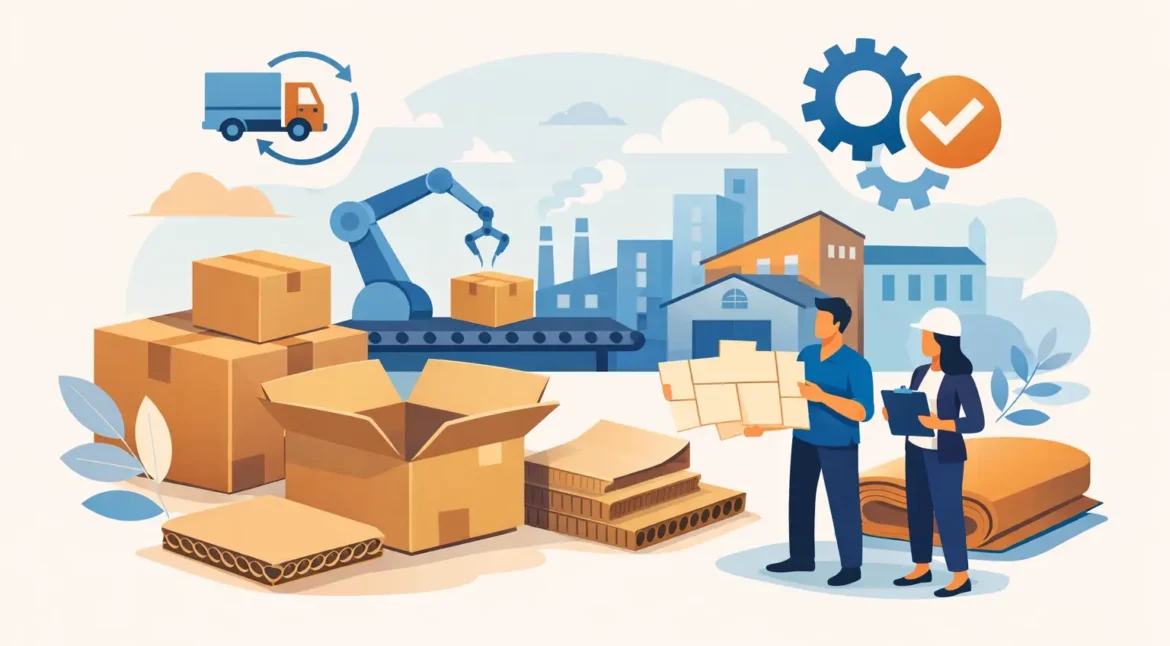
A box that jams an automated line, arrives late, or fails in transit is not a packaging problem alone. It becomes a production problem, a freight problem, and a customer service problem. That is why custom corrugated boxes for manufacturers should be evaluated as part of total operating cost, not just unit price.
Manufacturers rarely have the luxury of treating packaging as an isolated purchase. A corrugated box has to perform on the plant floor, protect the product through handling and shipping, and fit the realities of storage, lead times, and replenishment. When those pieces line up, packaging supports throughput. When they do not, the hidden costs show up fast in downtime, waste, damage claims, and excess inventory.
Why custom corrugated boxes for manufacturers matter
Standard boxes have their place, especially for stable product lines with simple handling requirements. But many manufacturing environments are not simple. Product dimensions vary. Weight distribution is uneven. Parts need dividers, pads, or die-cut inserts. Pallet patterns matter. So does whether boxes are hand-packed, machine-erected, stacked in warehouse racks, or shipped across long distances.
Custom corrugated packaging gives manufacturers more control over those variables. The right design can reduce void space, improve cube utilization, and prevent product shifting. It can also help labor teams pack faster and more consistently. In operations where time is money, a few seconds saved per pack-out can add up quickly.
There is also a purchasing reality to consider. The cheapest box on paper can become the most expensive option if it creates damage, slows handling, or requires extra filler and rework. For procurement and operations teams, the better question is not just, What does the box cost? It is, What does the packaging system cost us across the full process?
What a well-designed box should do on the floor
For manufacturers, packaging performance starts before a shipment ever leaves the dock. A corrugated box should fit the product correctly, hold up under expected stacking conditions, and move through packing stations without creating friction. If a box is too large, you pay for wasted material and extra freight space. If it is too small or poorly structured, you risk compression failure, split seams, or product damage.
Board grade and flute selection matter here. A heavier board is not always better. Sometimes it adds cost without improving real-world performance. In other cases, a lighter design with the right flute profile and structural layout can protect the product while reducing material use and storage footprint. It depends on the product, the environment, and how the box will be handled from plant to final destination.
Die-cut features, hand holes, partitions, pads, and custom inserts can also improve efficiency when they are used for a clear operational reason. If they make packing faster, reduce movement, or improve presentation for a retail program, they can be a strong investment. If they add complexity without measurable value, they become overhead. Good packaging design is practical, not decorative.
Cost control starts with total system thinking
Manufacturers under pressure to reduce spend often focus first on unit pricing. That makes sense, but it is only part of the picture. Corrugated packaging affects labor, freight, storage, damage rates, and replenishment planning. Looking at all of those together usually leads to better decisions.
A right-sized box can lower dimensional shipping costs. A stronger structure can reduce product loss and customer complaints. A design that ships and stores efficiently can free up warehouse space. Just-in-time delivery can reduce the need to carry large packaging inventories on site. When those gains are coordinated, the result is lower total cost, even if the piece price is not the lowest option on the quote sheet.
This is also where supplier structure matters. Managing one vendor for boxes, another for protective packaging, and another for freight creates handoff risk. Delays, communication gaps, and mismatched priorities are common. Manufacturers that consolidate packaging design, sourcing, and logistics support often gain better visibility and faster problem resolution.
Choosing the right custom corrugated box design
The best box design depends on how your operation actually runs. A food producer shipping temperature-sensitive product has different priorities than an industrial manufacturer moving heavy components or a distributor shipping mixed SKUs. The right solution should reflect product characteristics, packing method, shipping distance, storage conditions, and customer expectations.
Product protection and load strength
Start with the basic question of what the box needs to withstand. Product weight, edge pressure, stacking height, humidity exposure, and transit conditions all affect board selection and box style. A design that performs well in a dry warehouse may not hold up the same way in a cold chain or high-moisture environment.
Pack-out speed and labor efficiency
If your team is folding, filling, taping, and palletizing at volume, box design directly affects labor. Easy-to-assemble cartons, better fit, and consistent dimensions can help keep lines moving. On automated or semi-automated lines, small dimensional issues can create repeated stoppages, which are expensive in a hurry.
Freight and pallet optimization
Box dimensions influence trailer utilization, pallet count, and storage density. Sometimes a minor redesign improves pallet configuration enough to create meaningful freight savings over time. That kind of gain does not always show up in a packaging quote, but it shows up clearly in transportation spend.
Why service matters as much as the box itself
Even the best packaging design will not help much if supply is inconsistent. Manufacturers need dependable lead times, responsive communication, and delivery schedules that align with production demand. A missed box shipment can stop output just as surely as a missing component.
That is why many manufacturers look beyond a traditional box supplier. They need a partner that can support package engineering, source multiple packaging components, manage inventory intelligently, and deliver on time. Warehousing, cross-docking, and just-in-time programs can reduce inventory pressure while helping plants avoid stockouts. Freight coordination adds another layer of control, especially when inbound packaging and outbound product movement affect the same production schedule.
TEC Business Solutions approaches this as an operational support function, not just a packaging transaction. That distinction matters when customer demand shifts, lead times tighten, or a packaging issue starts affecting throughput.
Common mistakes manufacturers make with corrugated packaging
One of the biggest mistakes is staying with a legacy box design simply because it has always been used. Over time, products change, case counts change, shipping zones change, and production methods change. Packaging should be reviewed with the same practical mindset applied to other operating inputs.
Another issue is overengineering. Some businesses compensate for past failures by specifying more board than necessary across the board. That may reduce risk in one area while quietly increasing material cost, cube, and handling inefficiency elsewhere. The better path is testing and designing for the real conditions the package will face.
A third mistake is separating packaging decisions from logistics decisions. If the packaging team is focused only on material cost while transportation is dealing with poor palletization or dimensional charges, the business misses the chance to improve total performance.
What to expect from a strong packaging partner
A good partner should ask detailed questions about your product, line setup, shipping profile, and service expectations. They should be prepared to recommend board and flute options, structural adjustments, and inventory strategies that fit your operation. They should also be realistic. Not every packaging change delivers savings, and not every custom feature is worth the cost.
You should also expect responsiveness. Manufacturing schedules do not leave much room for slow answers. When packaging is tied to throughput, support has to be timely and practical. That includes problem solving when forecasts change, lead times tighten, or a box needs to be redesigned to support a new product run.
The real value of custom corrugated boxes for manufacturers is not customization for its own sake. It is the ability to align packaging with production, warehousing, and shipping in a way that lowers friction across the whole operation.
For manufacturers trying to protect margins, improve uptime, and simplify supply relationships, the right corrugated box is more than a container. It is one of the quieter ways to make the entire business run better.