
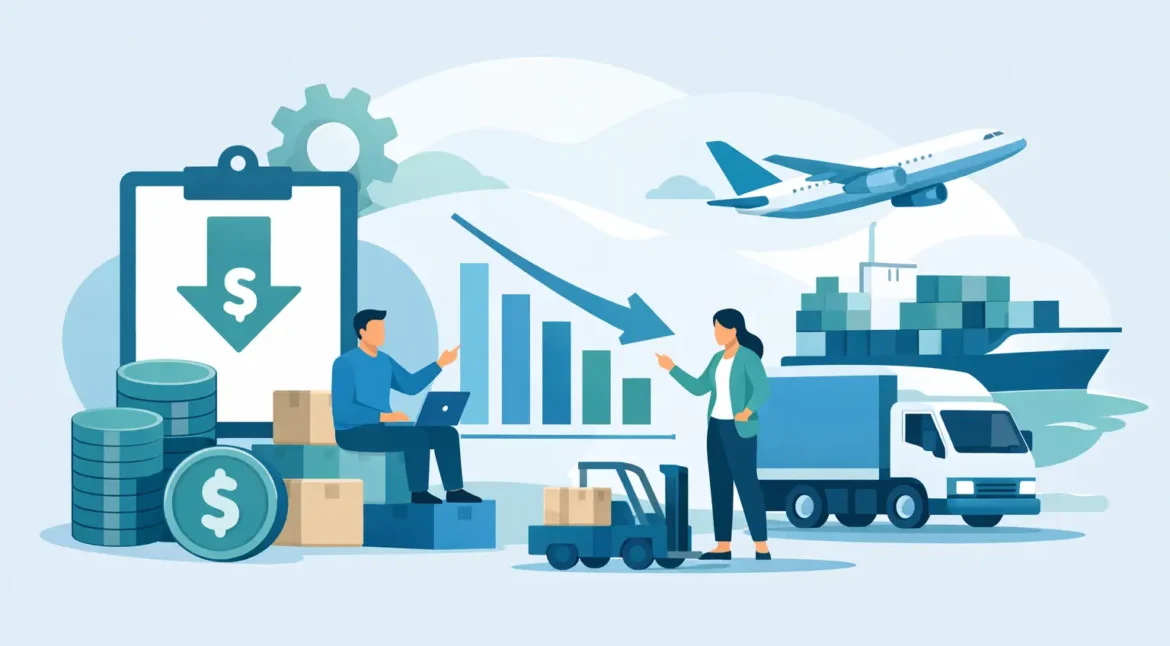
Freight spend usually creeps up long before it becomes a line-item crisis. A few rushed shipments here, a handful of oversized cartons there, and suddenly margins are getting squeezed by decisions that felt harmless at the time. If you are looking at how to lower freight costs, the fastest gains often come from fixing the small operational habits that quietly raise your landed cost every day.
For manufacturers, food producers, and distributors, freight is rarely just a transportation issue. It is tied to packaging design, order patterns, warehouse timing, and supplier coordination. That is why the most effective cost reduction work starts by looking at the full movement of the product, not just the carrier invoice.
How to lower freight costs by finding the real cost drivers
Many companies start with rate shopping. That has value, but it is rarely enough on its own. If your shipments are cubing out before they weigh out, if your order profiles create partial loads, or if your dock schedule forces premium pickups, a lower linehaul rate will only trim around the edges.
Start by identifying what is actually driving spend. Look at shipment size, freight class, packaging dimensions, damage claims, accessorial charges, detention, re-delivery, and the percentage of expedited orders. In many operations, the biggest problem is not that rates are too high. It is that the shipment itself is poorly configured for efficient movement.
This is where operations leaders often find the clearest opportunity. When production, packaging, warehousing, and transportation are managed separately, each team may be making a reasonable decision for its own function while increasing total cost for the business.
Packaging decisions have a direct impact on freight costs
A box is not just a box when freight is involved. Carton dimensions, flute profile, internal protection, pallet pattern, and stackability all affect how efficiently product moves through the supply chain. If the package is larger than it needs to be, you may be paying to ship air. If it is under-engineered, damage and replacement costs can erase any savings from lighter materials.
The right packaging design lowers freight costs in several ways at once. It can reduce dimensional weight, improve pallet density, increase trailer utilization, and protect the product well enough to prevent claims and reshipments. For some operations, a redesign that removes even a small amount of carton size across high-volume SKUs can lead to meaningful annual savings.
There is a trade-off, though. The lowest material cost does not always produce the lowest delivered cost. A cheaper package that slows packing lines, creates instability in transit, or increases damage can cost more in the long run. The goal is not to buy the least expensive packaging. The goal is to engineer packaging that supports efficient production and efficient freight movement at the same time.
Reduce dimensional weight and wasted cube
Dimensional pricing has changed the economics of shipping. If your packages are light but bulky, carriers are charging based on the space they consume, not just their weight. That makes package sizing one of the most practical ways to reduce spend.
Review your highest-volume cartons and compare product dimensions to carton dimensions. Look for extra void space, unnecessary inserts, and poor pallet fit. A better-sized carton can improve parcel cost, LTL density, and truckload loading efficiency. In some cases, custom corrugated solutions or die-cut packaging can reduce cube enough to affect every shipment that follows.
Improve pallet configuration and trailer utilization
Freight costs rise when pallets are unstable, underfilled, or inefficiently stacked. A stronger corrugated design, better partitions, or a revised case pack can allow higher stacking, better load integrity, and more product per trailer. That means fewer shipments over time, which is where major savings start to show up.
For plant managers and procurement teams, this is often an overlooked area because the packaging line is judged on speed and unit cost. But freight performance should be part of the conversation. Better palletization can improve both.
Tighten shipment planning before orders become expensive
A surprising amount of freight inflation comes from urgency. Late production runs, inconsistent inventory positions, and poor order visibility lead to expedited shipments, split shipments, and avoidable premium charges. Time is money, and rushed freight proves it every day.
If you want to know how to lower freight costs without hurting service, focus on planning discipline. Align production schedules with shipping windows. Build more visibility into packaging and raw material availability. Review customer order cutoffs and identify where small scheduling changes could create more consolidation.
This does not mean every business should hold more inventory. In some environments, that creates its own cost problems. But it does mean your freight strategy should be tied to inventory and production planning. When those functions operate in sync, you gain more control over mode selection and load building.
Consolidate shipments whenever the order profile allows it
Freight gets expensive when you move too many small shipments. Consolidation is one of the clearest paths to lower cost, whether that means combining customer orders, shipping on scheduled lanes, or using cross-docking to build fuller outbound moves.
The best approach depends on your business model. A food producer shipping time-sensitive orders may have less flexibility than an industrial distributor with recurring customer schedules. Still, most operations have at least some room to reduce shipment frequency and improve load efficiency.
Consolidation also requires communication. Sales may promise delivery patterns that drive cost. Customer service may release orders in ways that prevent efficient planning. Transportation teams need usable lead time to build the right move. If each department acts independently, freight costs will stay higher than they need to be.
Use carrier strategy, not just carrier quotes
Carrier procurement matters, but the lowest quote is not always the best choice. Service reliability, claim rates, appointment performance, geographic strength, and communication all affect total cost. A cheaper carrier that misses pickups or creates frequent delivery exceptions can trigger production delays, customer complaints, and emergency recovery shipments.
A stronger carrier strategy starts with lane data. Know where you ship most often, which modes you use, how often you pay accessorial charges, and where service breaks down. With that information, you can match carriers to freight characteristics instead of using the same approach for every shipment.
In some cases, the answer is a tighter core carrier program. In others, it may be working with a freight management partner that can bring broader coverage and rate leverage across truckload, LTL, and specialized moves. The right model depends on volume, lane complexity, and internal staffing.
Watch the charges outside the base rate
Base rates get attention because they are easy to compare. Accessorials are where many budgets get damaged. Liftgate charges, residential delivery, limited access, detention, reclassification, and appointment fees can quietly push a shipment well above the quoted rate.
Review invoices for patterns. If accessorials are recurring, they are not exceptions anymore. They are operational issues that should be corrected at the source. Better shipment data, cleaner BOLs, more accurate classification, and improved dock readiness can remove a meaningful amount of cost without changing carriers at all.
Build freight savings into vendor and warehouse decisions
Freight performance is also affected by where inventory sits and how suppliers deliver to you. If inbound shipments arrive in inefficient quantities, or if packaging suppliers cannot support just-in-time delivery, you may end up paying more for storage, emergency replenishment, and fragmented outbound shipping.
This is one reason many companies benefit from working with partners that can support packaging supply, warehousing, and freight coordination together. When sourcing, package engineering, inventory support, and transportation are aligned, it becomes easier to reduce touches, shorten lead times, and avoid unnecessary movement. TEC Business Solutions approaches it from that operational point of view because cost control usually improves when fewer handoffs stand between production and delivery.
That integrated model is especially useful when your business is balancing multiple priorities at once: protecting product, supporting line efficiency, controlling packaging spend, and meeting tight customer delivery requirements. Freight savings are more durable when they come from a system that works better, not a temporary rate concession.
Measure the right results
Freight cost per shipment only tells part of the story. You should also look at freight cost per unit shipped, on-time performance, claim frequency, trailer utilization, expedited shipment percentage, and total delivered cost. A change that lowers one metric while hurting service or increasing damage is not really a win.
That is why the best freight reduction work is practical and steady. You test a packaging change. You review lane performance. You tighten release timing. You fix the recurring accessorials. Over time, those improvements compound.
If freight costs have been climbing, the answer is rarely one dramatic move. It is a series of smarter operating decisions that reduce waste without creating new problems. Start where the friction is most visible, and work backward from the shipment to the process that created it. That is usually where the real savings are hiding.