
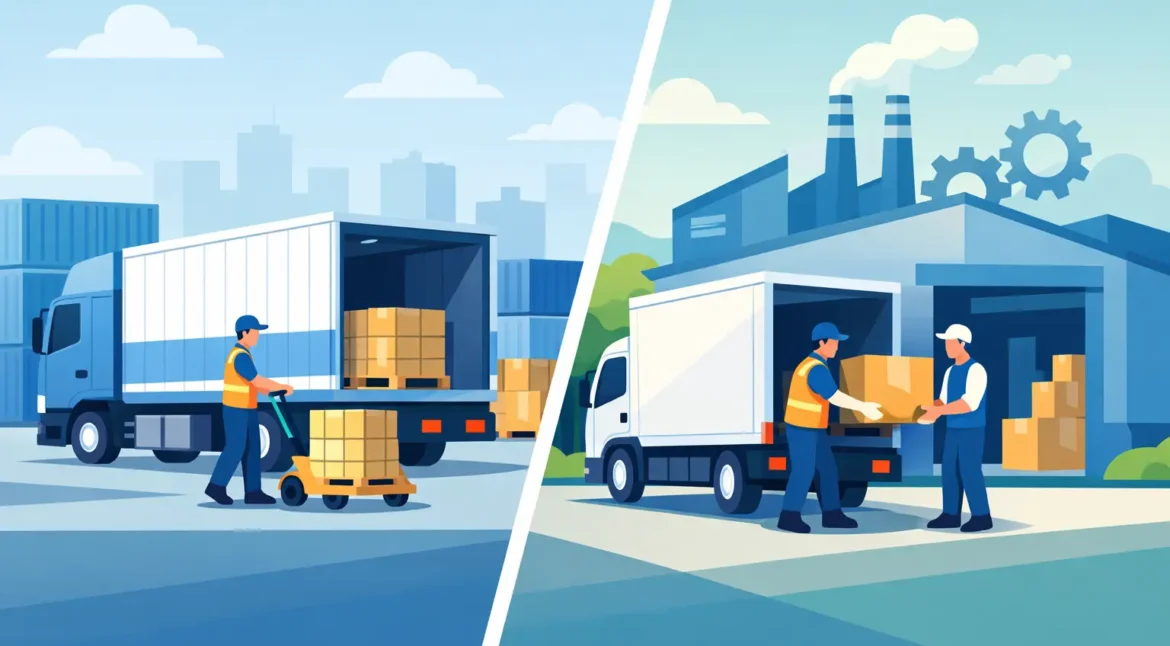
A trailer that arrives one day late can stop a production line, delay a customer order, or force a warehouse team into costly overtime. That is why the LTL freight vs dedicated delivery decision should not be based on a freight rate alone. The right choice depends on shipment size, delivery urgency, product requirements, handling risk, and the real cost of disruption at the receiving location.
For manufacturers, food producers, and distributors, transportation is part of the operating plan. Packaging, raw materials, finished goods, and retail displays all have to move on time and arrive in usable condition. Understanding where LTL makes sense and where dedicated delivery protects the business can reduce freight spend without creating avoidable service failures.
LTL Freight vs Dedicated Delivery: The Basic Difference
Less-than-truckload freight, usually called LTL, combines shipments from multiple customers in one trailer. A carrier picks up freight from several shippers, moves it through terminals or consolidation points, and delivers it alongside other loads. Because trailer space is shared, each shipper pays for the portion of capacity used rather than the cost of an entire truck.
Dedicated delivery assigns a truck, driver, and equipment to one customer or one planned route. The vehicle may carry a full truckload, a partial load, or multiple stops for the same shipper, but it is not built around combining unrelated freight from different customers. The shipment generally moves directly from origin to destination, with fewer transfers and more control over timing.
Neither option is automatically better. LTL is often the efficient answer for smaller, flexible shipments. Dedicated delivery becomes more valuable when a delivery window, product condition, production schedule, or total shipment volume makes shared transportation too risky or too expensive in practice.
When LTL Freight Is the Right Cost-Control Tool
LTL works well when freight does not fill a trailer and delivery timing has reasonable flexibility. A distributor replenishing regional inventory, for example, may send several pallets to a customer without paying for unused full-truckload space. A manufacturer can also use LTL to move lower-volume shipments to customers across a broad geographic area.
The primary advantage is cost allocation. If a shipment occupies six pallets instead of 26, paying for six pallets of trailer capacity can be much more sensible than paying for a dedicated truck. LTL also gives businesses access to established carrier networks, scheduled pickup options, and broad delivery coverage without managing a private fleet.
However, the quoted rate is only part of the cost. LTL pricing can be affected by freight class, density, dimensions, origin and destination, fuel, residential or limited-access delivery conditions, liftgate needs, appointment requirements, and other accessorial charges. Freight that is poorly classified, improperly packaged, or difficult to handle can create unexpected charges after pickup.
LTL also involves more handling. Pallets may be loaded and unloaded at terminals as they move through the carrier network. For durable, well-unitized freight with flexible delivery needs, that process can be acceptable. For fragile displays, moisture-sensitive materials, high-value components, or time-critical production inputs, each additional touch point raises the potential for damage, delay, or loss.
LTL is typically a strong fit when:
- The shipment uses only a portion of a trailer.
- Delivery can tolerate a broader transit window.
- Freight is securely packaged and able to withstand terminal handling.
- Multiple smaller orders are moving to different destinations.
- The savings from shared capacity outweigh the cost of a longer, less controlled transit path.
A strong packaging plan matters here. Proper carton strength, pallet configuration, stretch wrap, corner protection, and load securement help freight move through an LTL network with fewer claims and fewer rejected shipments.
When Dedicated Delivery Is Worth the Premium
Dedicated delivery is designed for control. The truck is scheduled around the shipper’s needs, not around a carrier’s terminal network or unrelated freight. That can mean a direct trip from plant to customer, a timed delivery to support production, or a multi-stop route that serves a defined group of locations.
The rate may look higher than LTL at first glance, especially for a load that does not fill the trailer. But the better question is whether the total cost is lower after accounting for downtime, expediting, damage exposure, labor disruption, and missed customer commitments.
Consider a food producer shipping packaging materials to a plant that runs on a just-in-time schedule. If an LTL delay leaves the facility without the cartons needed for a production run, the resulting labor and equipment costs can quickly exceed the difference between an LTL rate and a dedicated truck. The same logic applies to components needed for assembly, seasonal retail displays tied to a launch date, or finished goods required for a firm customer appointment.
Dedicated service also reduces handling. Freight stays on one vehicle from pickup through delivery in many cases, limiting terminal transfers and the associated opportunities for damage. This is especially useful for unusual dimensions, fragile products, high-value goods, temperature-sensitive materials, or loads that require special handling.
A dedicated truck can also improve dock planning. A plant manager knows when the vehicle will arrive. Warehouse teams can stage the load, arrange labor, prepare equipment, and avoid the stop-start work that occurs when deliveries arrive unpredictably.
The Cost Comparison Must Include More Than Freight Rates
Comparing LTL and dedicated delivery by price per shipment can produce the wrong decision. A lower LTL quote is meaningful only if the delivery performs as required. Operations leaders should look at total landed transportation cost, including both freight expense and the operational impact of the shipment.
Start with shipment density and volume. As pallet count, weight, and cube increase, LTL rates can climb quickly. At a certain point, the cost gap between LTL and a dedicated truck narrows. A shipment that uses most of a trailer may be a dedicated candidate even if it does not technically fill every available foot of space.
Next, evaluate the value of the delivery window. Is the receiving location open only during limited hours? Does the shipment support a production run, an installation crew, or a customer launch? Is a missed appointment subject to fees? The more expensive a late delivery becomes, the more valuable direct transportation control can be.
Then assess handling risk. LTL can be dependable, but it is a network service with multiple freight movements. Dedicated delivery generally has fewer handoffs. If a single damaged pallet can interrupt production or trigger a rejected order, using the lowest-cost mode may not be the lowest-cost business decision.
Finally, consider how often the shipment pattern repeats. A one-time shipment may be handled transactionally. Regular lanes create opportunities to plan pickups, consolidate volume, set delivery schedules, and build a transportation approach that supports the entire supply chain rather than one order at a time.
A Practical Decision Process for Each Shipment
The best transportation decisions begin before the freight is ready at the dock. Procurement, operations, and logistics should share the information that affects service requirements: order quantity, packaging dimensions, required arrival date, dock restrictions, product sensitivity, and the consequence of delay.
For smaller shipments with flexible timing, obtain an LTL option and verify the service details. Confirm freight class or density, pickup requirements, delivery appointment needs, and any accessorial charges that could change the final invoice. Make sure the freight is packaged for terminal handling, not simply for storage or local movement.
For larger, time-sensitive, or higher-risk shipments, price dedicated delivery against the full operating cost of an LTL failure. A dedicated truck may be the better decision when it protects a critical customer relationship, avoids an expedited replacement shipment, or prevents a line shutdown.
There is also a middle ground. Consolidating several smaller orders into a scheduled dedicated route can improve cost per unit while giving the shipper more control than separate LTL shipments. Cross-docking and short-term warehousing can support this strategy by holding freight until a planned route is ready, rather than sending every order immediately at a premium.
Transportation Planning Works Best With Packaging Planning
Freight decisions and packaging decisions are closely connected. A poorly designed pallet load wastes trailer space, increases damage risk, and can push a shipment into a more expensive freight category. Right-sized cartons, efficient pallet patterns, protective packaging, and consistent load heights improve cube utilization and make both LTL and dedicated transportation more efficient.
That is where an integrated partner can make a practical difference. TEC Business Solutions helps customers look beyond the box price or freight quote to the complete operating cost – including package design, inventory flow, freight coordination, and delivery reliability. Time is money, especially when production and customer commitments depend on the next truck arriving as planned.
The right choice is the one that gives your operation the needed service at the lowest total cost. Use LTL when shared capacity supports the shipment without adding unacceptable risk. Use dedicated delivery when control, direct handling, and schedule certainty protect a larger business outcome. Build that decision into the shipping process before the freight reaches the dock, and transportation becomes a tool for keeping production moving instead of another source of uncertainty.