
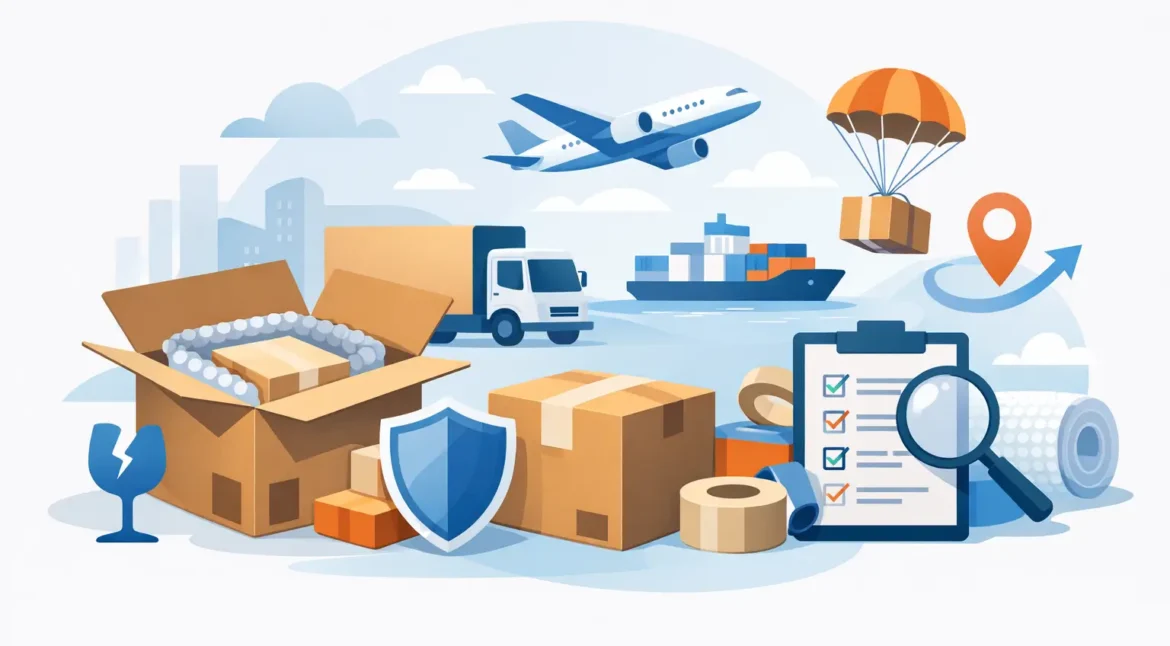
A damaged shipment rarely shows up as one problem. It shows up as a chargeback, a production delay, a customer complaint, a rush replacement order, and a freight bill you end up paying twice. That is why a strong guide to transit damage prevention is not just about packaging. It is about protecting margin, keeping operations moving, and reducing avoidable friction across your supply chain.
For manufacturers, food producers, and distributors, transit damage usually starts well before a truck leaves the dock. The root cause is often a mismatch between product fragility, pack design, unitization, handling methods, and the actual conditions of the shipping lane. If any one of those variables is off, damage rates climb. If several are off, claims become routine.
What transit damage is really costing you
The visible cost is easy to track. You see product loss, replacements, returns, and freight claims. The hidden cost is often larger. Teams spend time reworking orders, customer service absorbs complaints, purchasing scrambles for emergency materials, and plant schedules get disrupted when replacement runs jump the line.
That is why transit damage prevention should be treated as an operating cost issue, not a packaging line item. A cheaper carton that fails under stacking pressure is not cheaper. A lighter packout that increases breakage is not a savings. In most operations, the right question is not, “What does the box cost?” It is, “What does delivered performance cost us over time?”
A practical guide to transit damage prevention
The most effective approach starts with the full shipping environment. Products do not move through ideal conditions. They move through forklift contact, conveyor transfers, trailer vibration, compression under stacked loads, temperature changes, and occasional mishandling. Packaging has to perform in that real-world system.
Start with the product and the failure mode
Not all damage is the same, and not all products need the same solution. Some items crack from shock. Others get crushed from top load. Flexible packaging may puncture. Food shipments may lose integrity when moisture weakens corrugated structure. Printed retail packaging may still protect the product but arrive with visible cosmetic damage that customers reject.
Before changing materials, define what is failing. Look at claim photos, warehouse observations, carrier notes, and receiving feedback. If corners are collapsing, that points you in a different direction than abrasion, burst, or shifting contents. The goal is to solve the actual failure mode instead of adding material where it does not help.
Match board strength and package design to the lane
One of the most common mistakes is specifying packaging based on product weight alone. Weight matters, but it is only part of the equation. Box dimensions, stacking height, pallet pattern, humidity exposure, and shipping distance all affect performance.
A long regional route with multiple touches may require more protection than a short dedicated lane. A frozen or refrigerated environment may call for materials that hold strength under moisture exposure. A tall, narrow pack may need better internal stabilization than a compact case of the same weight. Good packaging design is not about overbuilding everything. It is about selecting the right corrugated flute, board grade, die-cut structure, partitions, pads, or protective components for the actual distribution cycle.
Improve fit, not just thickness
Adding more material can help, but it is not always the best fix. Loose product movement inside the package is a major cause of transit damage, and thicker outer packaging will not solve poor internal fit. If contents are shifting, colliding, or settling during transport, you may need partitions, pads, inserts, or a redesigned interior layout.
This is especially important for mixed loads, fragile components, and products with irregular shapes. A package that holds the product in place often outperforms a heavier package that still allows movement. Better fit can also reduce cube, which may improve trailer utilization and lower freight cost.
Palletization is part of transit damage prevention
A well-designed case can still fail if the pallet load is unstable. Unit load performance matters because most damage happens after products are packed but before they are delivered. Forklift handling, trailer movement, and warehouse stacking all test the integrity of the full load.
Build stable loads from the ground up
Start with a pallet in good condition and the right size for the case footprint. Overhang creates weak points and increases crush risk. Poor alignment leads to leaning loads and shifting during transit. If cases are not interlocked or column stacked correctly for the product and board type, load strength can drop quickly.
Stretch wrap also needs attention. Too little containment allows movement. Too much can deform lighter cases. The right wrap pattern, tension, and film selection depend on load weight, case strength, and shipping conditions. Strap placement, corner protection, and top caps may also be needed, especially for taller loads or shipments that move through multiple handling points.
Review handling practices at the dock
Damage prevention is not only an engineering issue. It is also an execution issue. Even strong packaging will fail if loads are rammed by forklifts, double-stacked without support, or left exposed to conditions they were not designed to handle.
Dock teams should know the load limits, stacking rules, and orientation requirements for each shipment type. Clear labeling helps, but process discipline matters more. If the same product keeps arriving damaged, review how it is staged, loaded, and transferred. Many recurring damage issues can be reduced through better handling consistency before any material change is made.
Test, measure, and adjust
The fastest way to waste money is to make packaging changes based on assumptions. The better path is to test likely fixes against real conditions. Compression testing, drop testing, vibration testing, and field observation can reveal whether a design works before damage becomes a customer-facing problem.
There is always a trade-off. Heavier packaging may improve protection but raise material and freight costs. A lighter design may cut spend but reduce stacking strength. The right answer depends on the product value, claim frequency, lane conditions, and customer requirements. This is why the best transit damage prevention programs use data, not guesswork.
Track damage by SKU, customer, carrier, lane, and packaging configuration. Patterns usually emerge quickly. You may find that one customer location has stricter receiving standards, one route has repeated shock events, or one package style underperforms in humid storage. Once you can see those patterns, you can target improvements where they will pay back fastest.
Why packaging and freight need to work together
Transit damage is often treated as a packaging issue alone, but freight conditions matter just as much. Mode selection, trailer loading, handling frequency, and carrier performance all influence delivered outcomes. A package that works on a direct route may struggle in an LTL network with more touches. A stack pattern that performs in one trailer configuration may shift in another.
That is where an integrated approach creates value. When packaging design, warehousing, and freight coordination are managed with the same operating goal, you can reduce damage without creating new costs somewhere else. In practice, that means engineering for the actual lane, not an assumed one. It means aligning package specs with loading methods, storage conditions, and customer expectations.
For businesses managing tight production schedules, this coordination matters. Time is money. Every preventable damage claim pulls attention away from throughput, service, and cost control.
Where to focus first
If you want results quickly, start with your highest-cost damage category rather than trying to redesign everything at once. That could be one fragile SKU, one unstable pallet pattern, one moisture-sensitive package, or one shipping lane with repeat claims. Fixing the biggest source of loss first usually creates the clearest return.
From there, standardize what works. Document approved packouts, pallet patterns, wrap settings, and handling instructions. Train teams to those standards and review performance regularly. The goal is consistency. A strong design only delivers savings if it is used the same way every time.
Companies that treat transit damage prevention as part of total operating cost usually outperform those that chase the lowest unit price on packaging. That is the difference between buying boxes and building a system that protects products from production through delivery. TEC Business Solutions works best in that environment because the packaging decision, the warehouse reality, and the freight plan are all connected.
The shipments that arrive intact are rarely the result of luck. They are the result of design choices, process discipline, and partners who understand how products move in the real world.