
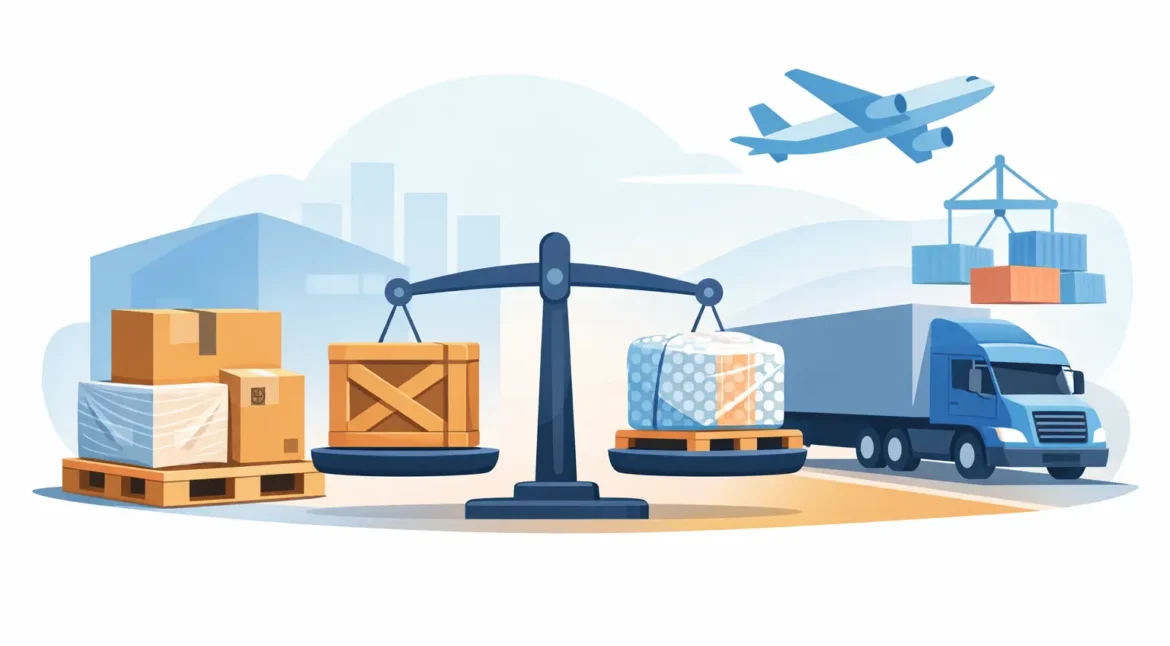
If two pallets weigh the same and move on the same lane, they can still ship at very different LTL costs. The reason is often packaging. For manufacturers, distributors, and food producers, understanding how packaging affects freight class is not a technical side issue. It directly influences rates, claims exposure, warehouse efficiency, and the total cost to deliver product.
Freight class is not just about what you ship. It is also about how you prepare it for the carrier. Packaging changes density, stackability, handling requirements, and the likelihood of damage. Those factors can move a shipment into a higher or lower class, which then affects what you pay.
How packaging affects freight class in practical terms
Under the National Motor Freight Classification system, freight class for LTL shipments is based on four main characteristics: density, stowability, handling, and liability. Packaging touches every one of them.
That matters because many businesses focus on unit packaging cost and miss the larger freight picture. A cheaper box, more void fill, or an oversized pallet may look fine on a purchase order, but it can increase transportation spend month after month. Time is money, and so is cube.
Density starts with package design
Density is one of the biggest drivers of freight class. In simple terms, carriers look at how much a shipment weighs compared to how much space it takes up. Packaging has a direct impact on that equation.
If your product is packed in a carton with excess empty space, oversized end caps, heavy fillers, or unnecessary outer packaging, your shipment takes up more cubic feet without adding useful weight. That lowers density, and lower density often means a higher freight class. Higher class usually means a higher rate.
On the other hand, right-sized packaging can improve density without compromising product protection. A better fit carton, a stronger corrugated flute that allows less wasted space, or a tighter pallet pattern can reduce cube and improve class. The savings can show up every time that SKU moves.
There is a trade-off, though. You cannot simply shrink packaging to chase a denser shipment if the result is more damage or slower packing lines. The best packaging design balances freight efficiency with product protection and production realities.
Pallet footprint and load height matter more than many shippers expect
Freight class is not assigned in a vacuum. Carriers see what arrives at the dock. A pallet that overhangs, leans, or has inconsistent dimensions creates handling and stowability concerns, even if the product itself is straightforward.
Packaging design influences how cleanly freight builds on a pallet. Cartons that interlock well, partitions that stabilize product, and corrugated solutions designed around pallet dimensions help create a compact and uniform load. That improves trailer utilization and reduces the chance that the shipment is treated as awkward or difficult to handle.
In contrast, unstable pallet loads, mixed carton sizes, or packaging that cannot support top load can work against you. If the freight cannot be stacked or safely positioned with other shipments, a carrier may view it as less stowable. That can contribute to a higher class or trigger pricing exceptions.
Packaging can change handling requirements
Handling is another area where packaging affects freight class. Carriers price around labor, equipment, and risk. When packaging makes freight harder to move, the shipment becomes more expensive to handle.
A well-designed package protects the product while making the load easier to forklift, stack, and transfer through terminals. Standard footprints, secure palletization, and packaging that resists crushing all support smoother handling.
By comparison, irregular cartons, weak corrugated walls, poor stretch wrap, or packaging that shifts in transit can cause problems at every touchpoint. Freight that needs special attention slows terminal operations. That is exactly the kind of shipment carriers do not want to handle at standard pricing.
This is especially relevant for fragile products, food shipments, components with uneven weight distribution, and high-volume industrial items. The packaging has to do more than contain the product. It has to support the way freight actually moves.
Liability is not only about the product value
Liability within freight class reflects the likelihood of theft, damage, breakage, or claims. Packaging plays a major role here.
A durable, properly engineered package can reduce visible vulnerability and protect goods from compression, punctures, and vibration. Better protective packaging, stronger outer cartons, and smarter internal dunnage reduce the odds of a claim. Over time, that matters not only for product replacement costs but also for carrier relationships and freight strategy.
Poor packaging has the opposite effect. If goods arrive with exposed edges, weak corner support, inadequate partitions, or inconsistent pallet security, the shipment presents more damage risk. That can influence classification and can certainly increase total landed cost, even if the initial freight rate looks competitive.
For many shippers, this is where the real cost conversation begins. Saving pennies on packaging while absorbing claim costs, customer dissatisfaction, and reorder freight is rarely a win.
Why class disputes often start with packaging details
One of the most common LTL frustrations is a reclass. A shipment is tendered under one class, then the carrier inspects dimensions, density, or packaging characteristics and changes it. The adjusted invoice shows up later.
Packaging is often at the center of that issue. If actual pallet dimensions differ from what was quoted, if packaging creates lower density than expected, or if the load appears harder to handle than described, the original class may not hold.
That is why consistency matters. If the same product ships in different carton sizes from one order to the next, or if pallet heights vary by plant or shift, your freight profile becomes harder to control. Standardized packaging helps standardize classification.
It also helps to document packaging specifications clearly. Accurate dimensions, true shipment weight, and repeatable pallet configurations reduce surprises. In many operations, packaging engineering and freight management need to work closer together than they currently do.
The lowest packaging cost is not always the lowest delivered cost
Procurement teams are under pressure to reduce material spend. That is reasonable. But packaging decisions made in isolation can create hidden transportation costs.
A lighter board grade might lower carton cost but fail under stacking pressure, which increases damage risk and handling concerns. A larger stock box may simplify purchasing but reduce density across hundreds of shipments. More protective fill may help with breakage but inflate dimensions enough to raise class.
The right question is not just, What does this package cost? The better question is, What does this package do to total operating cost from packing through delivery?
That broader view is where experienced packaging support adds value. Companies that treat packaging, warehousing, and freight as connected functions usually find more room for savings than companies that manage them separately.
How to improve freight class through better packaging decisions
The first step is to evaluate your highest-volume and highest-cost LTL shipments. Look at carton dimensions, pallet patterns, average shipment density, claim history, and any recurring reclass charges. Patterns tend to show up quickly.
From there, review whether the packaging is oversized, inconsistent, or stronger in some areas than necessary and weaker in others. Sometimes a custom corrugated design improves both protection and cube. In other cases, better partitions, pads, or pallet configuration make the bigger difference.
It also helps to test packaging in real operating conditions, not just in theory. What works in a lab may not work on a production line or through a cross-dock environment. Good packaging has to support speed, product integrity, and freight efficiency at the same time.
If you ship a mix of products, the answer may vary by SKU. Dense industrial parts, baked goods, meat products, and retail displays do not all behave the same in transit. Freight class strategy should reflect that reality.
For businesses trying to reduce transportation spend, this is where an integrated approach pays off. When packaging design, warehousing support, and freight coordination are aligned, you can make decisions based on total cost instead of isolated line items. That is the difference between buying boxes and solving supply chain problems.
A practical review of packaging can uncover opportunities to increase density, improve stackability, reduce handling issues, and lower claim exposure without disrupting production. TEC Business Solutions works with customers in exactly that space, where packaging performance and freight performance have to support each other.
The shipment your carrier sees is the shipment your packaging creates. When packaging is engineered with freight class in mind, you give your operation a better chance to control cost before the truck ever leaves the dock.