
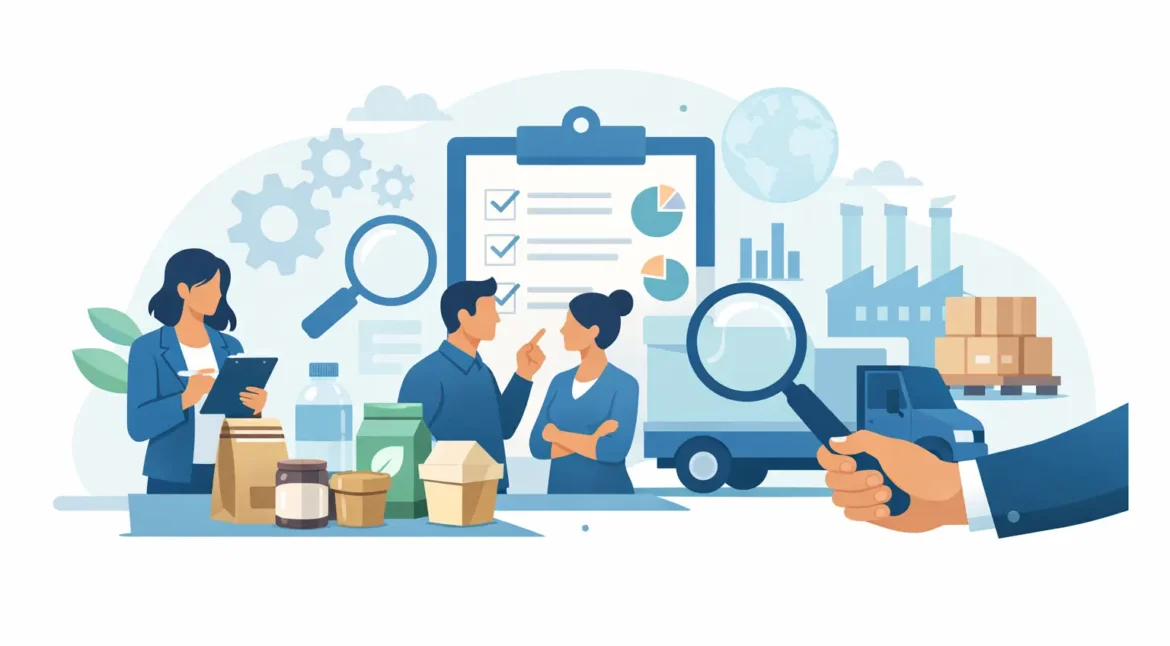
A late trailer, a missed carton spec, or a supplier that cannot flex with your production schedule can turn a normal week into overtime, expedited freight, and avoidable waste. That is why choosing food packaging suppliers is not a purchasing exercise alone. It is an operating decision that affects throughput, product quality, warehouse space, and delivery performance.
For food manufacturers, processors, bakeries, distributors, and private label brands, packaging is tied directly to plant efficiency. The right supplier helps you protect product, support line speed, and control total landed cost. The wrong one creates recurring friction that shows up in downtime, damage claims, inconsistent inventory, and constant fire drills.
What food packaging suppliers should really deliver
Many companies start with price per unit. That matters, but it is rarely the full story. A lower carton cost does not help much if board performance is inconsistent, lead times are unreliable, or your team is forced to carry excess inventory to compensate for poor service.
Strong food packaging suppliers should deliver more than boxes or materials. They should understand how packaging performs on the floor, how it stacks in storage, how it handles in transit, and how replenishment affects your labor and freight costs. In practical terms, that means they should be able to support structural design, material selection, schedule flexibility, and delivery planning.
The best suppliers also understand that food operations do not run on ideal conditions. Forecasts change. Promotions hit faster than expected. Seasonal volume compresses lead times. When that happens, responsiveness matters as much as unit price.
Start with operational fit, not just product availability
A supplier may have a broad catalog and still be a poor fit for your business. What matters is whether they can support the way your operation actually runs.
If you manage a high-volume production environment, packaging consistency is critical. Small variances in dimensions, flute strength, or print quality can slow machine performance or create rework. If you run multiple SKUs across facilities, standardization becomes just as important as supply continuity. In both cases, you need a supplier that can manage repeatability, documentation, and replenishment without constant intervention from your team.
This is where many buyers widen the evaluation beyond product categories. Corrugated cartons, meat boxes, bakery packaging boxes, partitions, pads, and sheets may all be available from different vendors, but spreading them across too many suppliers usually adds complexity. Separate purchase orders, inconsistent lead times, multiple delivery windows, and fragmented communication all create extra work inside your business.
A supplier with broader capabilities can often reduce that complexity. Not because consolidation is always the answer, but because fewer touchpoints usually mean faster issue resolution and better coordination when production needs shift.
Key questions to ask food packaging suppliers
The right conversation goes beyond, “What is your price?” Procurement, operations, and supply chain teams should be asking how a supplier will support the full packaging lifecycle.
Lead time is one of the first pressure points to test. Ask what is standard, what is realistic during peak demand, and how they handle urgent replenishment. Some suppliers quote aggressive timelines until demand spikes. Others build service models around just-in-time delivery, local warehousing, or cross-docking support that reduce the need for you to hold excess inventory.
Material performance is another critical area. A carton that performs well in a sample review may fail when exposed to moisture, stacking pressure, cold storage, or rough handling. Food packaging suppliers should be able to explain why a board grade, flute profile, or design is appropriate for your use case. If they cannot connect the packaging spec to real operating conditions, you may end up paying for preventable damage or overengineering.
It also helps to ask how they approach design changes. Packaging should not stay frozen just because it has always been done one way. Good suppliers look for opportunities to reduce material usage, improve cube efficiency, support automation, or simplify pack-out. Those changes can lower total cost, but they need to be tested carefully. A cost-down project that weakens protection or slows production is not a win.
Cost is bigger than the quote
Price pressure is real, especially in food manufacturing where margins can tighten quickly. But the lowest quote can become the highest-cost decision once the operation absorbs the consequences.
Freight is a common example. Bulky packaging takes up space, and inefficient ordering patterns can drive up transportation costs fast. A supplier that coordinates delivery schedules, shipment consolidation, and freight planning can help lower spend in ways a unit-price comparison will not show.
Inventory carrying cost is another hidden factor. If your supplier is inconsistent, you may be forced to stock extra packaging to protect production. That ties up cash, consumes warehouse space, and increases the risk of obsolescence when specifications change. On paper, the package price may look competitive. In practice, your business is paying more to compensate for poor supply reliability.
Then there is labor. If packaging arrives damaged, poorly bundled, mislabeled, or out of spec, your receiving and production teams pay for it in handling time and disruption. That is why experienced buyers look at total operating cost, not just purchase price.
Why service matters as much as supply
In food operations, service failure travels fast. A delayed delivery can affect production schedules. A quality issue can create waste. A communication gap can leave teams guessing when they should be executing.
That is why strong account management matters. The best suppliers are responsive, easy to reach, and capable of solving problems without layers of delay. They do not disappear after the order is placed. They stay engaged when forecasts move, specs change, or urgent needs arise.
This is also where an integrated partner can create measurable value. A company that combines packaging sourcing with engineering support, warehousing, and freight coordination can help remove friction across departments. Instead of treating packaging and transportation as separate problems, they are managed as part of the same operating system.
For many manufacturers, that model makes sense because packaging decisions affect delivery performance. Better load configuration, improved carton design, and tighter replenishment planning can all contribute to lower freight cost and fewer disruptions downstream. TEC Business Solutions is built around that kind of operational alignment, which is why the relationship often looks more like a service partnership than a simple vendor transaction.
Signs you may need a different supplier
Sometimes the need for change is obvious. More often, it builds slowly through recurring issues that become accepted as normal.
If your team is constantly expediting packaging, carrying more inventory than planned, or adjusting production around supplier limitations, that is not normal. If carton quality varies from run to run, if communication is reactive, or if every problem requires escalation, the supplier may be costing you more than they are saving.
Another warning sign is when your supplier only talks in terms of what they sell, not what your operation needs. Food packaging suppliers should be able to discuss packaging performance, line efficiency, storage constraints, and freight impact. If the conversation never gets past basic quoting, they are likely functioning as a commodity vendor rather than a business partner.
What a strong partnership looks like
A good supplier relationship should make your operation easier to run. Orders are accurate. Quality is consistent. Deliveries align with production needs. When issues come up, they get handled quickly and clearly.
Over time, the right supplier also helps you improve. They bring packaging ideas that reduce waste, support throughput, or lower freight exposure. They help you balance cost with performance instead of pushing a one-size-fits-all solution. And they understand that in food manufacturing, time is money. Delays, damage, and extra handling all show up somewhere on the P&L.
That is the standard worth holding. Food packaging is not just a line item. It is part of the system that moves product from production through delivery. Choose suppliers who understand that, and you will usually see the benefits far beyond the packaging budget.
When you evaluate your next supplier, look for the company that helps your plant run better on an ordinary Tuesday, not just the one that looks cheapest in a spreadsheet.