
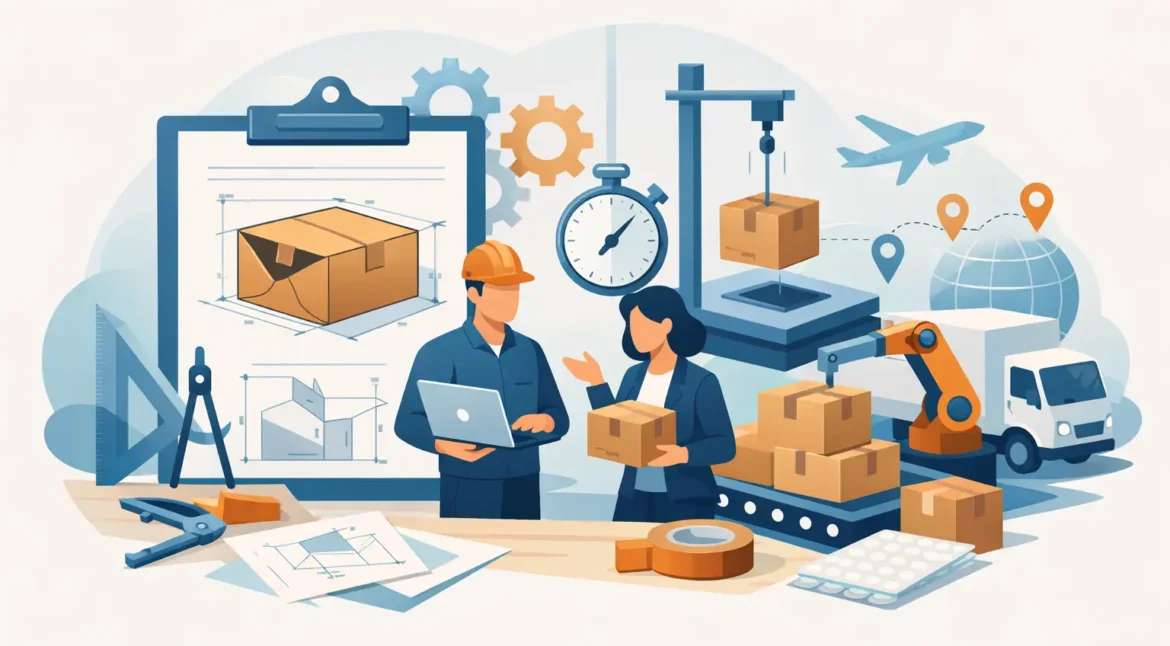
A packaging issue rarely starts in the packaging department. It shows up as line downtime, damaged product, rushed reorders, rising freight costs, or inventory that takes up more space than it should. That is why a real package engineering services guide has to start with operations, not with boxes. For manufacturers, food producers, and distributors, packaging decisions affect labor, storage, transportation, and customer satisfaction every day.
What package engineering services actually cover
Package engineering is the process of designing, testing, and improving packaging so it works in the real world of production and delivery. That includes material selection, structural design, pallet efficiency, product protection, and cost control. Good engineering does not stop at choosing the right corrugated board or box style. It looks at how packaging performs on the line, in the warehouse, on the truck, and at the customer site.
This is where many businesses lose money without realizing it. A carton might meet basic specs but still slow down packing, waste trailer space, or fail under stacking pressure. On paper, the unit cost may look acceptable. In practice, the total operating cost is higher.
Package engineering services are meant to solve that gap. The work often includes reviewing current packaging, identifying failure points, proposing new materials or designs, reducing excess material, and aligning packaging with production flow. In many operations, the right change lowers more than one cost at the same time.
Why manufacturers use a package engineering services guide
Most companies do not go looking for package engineering because they want more vendors involved. They do it because something in the operation is under pressure. Time is money, and packaging problems tend to hit several departments at once.
A procurement team may be focused on price stability and supplier reliability. Operations may need packaging that runs faster and more consistently on the line. Shipping may be dealing with product damage or cube inefficiency. Leadership may be looking for ways to reduce total landed cost without creating new risk. A practical package engineering services guide helps align those priorities instead of treating them as separate issues.
The strongest engineering support usually shows up in five areas: cost reduction, product protection, labor efficiency, inventory control, and freight performance. Those areas overlap more than most companies expect. A redesign that reduces board weight, for example, might also improve pallet count and free up warehouse space. A better die-cut or partition system may cut damage claims while also making packing more consistent.
Where packaging engineering creates the biggest savings
The first opportunity is often material optimization. Many companies are overpacked in some areas and underprotected in others. Engineers review flute profiles, board grades, dimensions, and structural features to find the right balance between performance and cost. The goal is not to use the cheapest material. The goal is to use the right material for the job.
The second area is line efficiency. Packaging that is awkward to form, fill, close, stack, or label adds labor minutes across every shift. Those minutes become real money fast. Small design changes can improve ergonomics, reduce touches, and help maintain output when demand spikes.
Freight is another major factor. Package dimensions affect pallet patterns, trailer utilization, and cross-dock handling. If the packaging takes up unnecessary space or creates unstable loads, transportation costs rise and service reliability suffers. Engineering that considers freight from the beginning can reduce both damage and shipping expense.
There is also an inventory angle. Standardizing packaging across SKUs where it makes sense can simplify purchasing and reduce storage complexity. That said, standardization is not always the right move. If it creates wasted space or weaker product protection, the downstream cost can erase the savings. This is where an experienced engineering review matters.
What to expect from a strong engineering partner
A supplier that only quotes cartons is not the same as a partner that supports operations. Strong package engineering services start with questions about your product, your equipment, your warehouse flow, and your delivery environment. They should want to understand how packaging performs from production through final destination.
In most cases, the process begins with an assessment of current packaging. That includes reviewing specs, usage patterns, damage history, freight conditions, and production requirements. Engineers may look at box styles, partitions, pads, protective packaging, corrugated sheets, and display needs depending on the application.
From there, recommendations should be practical, not theoretical. That means designs that can be sourced reliably, run consistently, and arrive on schedule. It also means understanding trade-offs. A lower-cost board substitution may work well for one shipping environment and fail in another. A custom die-cut may improve packing speed but increase lead time if not managed correctly. Good engineering advice makes those trade-offs clear.
The best partners also think beyond the packaging itself. If warehousing, just-in-time delivery, cross-docking, or freight coordination are part of the operation, engineering decisions should support those functions too. That broader view is often where the biggest gains happen.
How to evaluate your current packaging operation
If you are trying to decide whether engineering support is worth the effort, start by looking at a few practical signals. Repeated rush orders are one. Damage claims are another. So are inconsistent package quality, excessive packaging SKUs, poor pallet utilization, or line slowdowns tied to packing materials.
It also helps to compare price savings against total cost. A cheaper carton is not really cheaper if it increases freight spend, raises labor time, or causes customer complaints. Many operations are managing packaging one purchase order at a time when the better move is to review the system as a whole.
A useful internal review asks straightforward questions. Are package sizes matched to the product and shipping method? Are you carrying inventory that could be simplified? Are materials helping the line run smoothly or creating extra handling? Are shipments arriving with the consistency your customers expect? If the answers are mixed, engineering services can usually identify where money is leaking out.
Package engineering services guide for different industries
The right answer depends on the product and the supply chain. Food producers may need packaging that protects product integrity, stacks well in cold-chain environments, and arrives on a predictable schedule. Industrial manufacturers may be more concerned with heavy-duty protection, part separation, and packaging that supports repetitive handling. Distributors often need a balance of durability, cube efficiency, and packaging availability across changing order volumes.
For bakery, meat, and other food-related applications, packaging performance often comes down to both structural reliability and supply consistency. A missed delivery can disrupt production quickly. In industrial settings, protective packaging and corrugated design may need to account for abrasion, movement, or mixed-load shipping. Retail-oriented products may place more emphasis on appearance, display function, and ease of replenishment.
That is why one-size-fits-all packaging rarely holds up for long. There are cases where standard products are exactly the right fit. There are other cases where custom corrugated flutes, die-cut boxes, partitions, or pads produce better results. The key is matching the design to the operation rather than forcing the operation to work around the packaging.
Choosing a provider that can support more than design
Engineering recommendations only create value if they can be executed consistently. That is where service model matters. If your provider can design a better package but cannot support inventory planning, delivery timing, or freight coordination, the improvement may stall in day-to-day operations.
For many businesses, vendor consolidation is part of the savings strategy. Working with a partner that can combine packaging expertise, sourcing support, just-in-time delivery, and transportation coordination reduces handoffs and helps prevent service gaps. TEC Business Solutions is built around that model because packaging performance is tied directly to supply chain performance.
A dependable provider should be responsive when requirements change, realistic about lead times, and able to support both routine demand and urgent needs. They should also be comfortable discussing measurable outcomes such as reduced damage, lower material usage, improved production speed, and better freight efficiency. If the conversation stays limited to unit price, the bigger opportunity is being missed.
What a good decision looks like
The best packaging decision is not always the most customized option or the lowest-cost quote. It is the solution that protects the product, supports throughput, controls total cost, and arrives when you need it. That can mean a redesign. It can also mean simplifying what you already use and tightening up the supply process.
If your packaging is causing delays, waste, or avoidable freight expense, the issue is bigger than materials alone. A strong package engineering review gives you a clearer view of what is happening across production, warehousing, and delivery – and what to fix first. When packaging starts working as part of the operation instead of against it, the savings tend to show up faster than expected.