
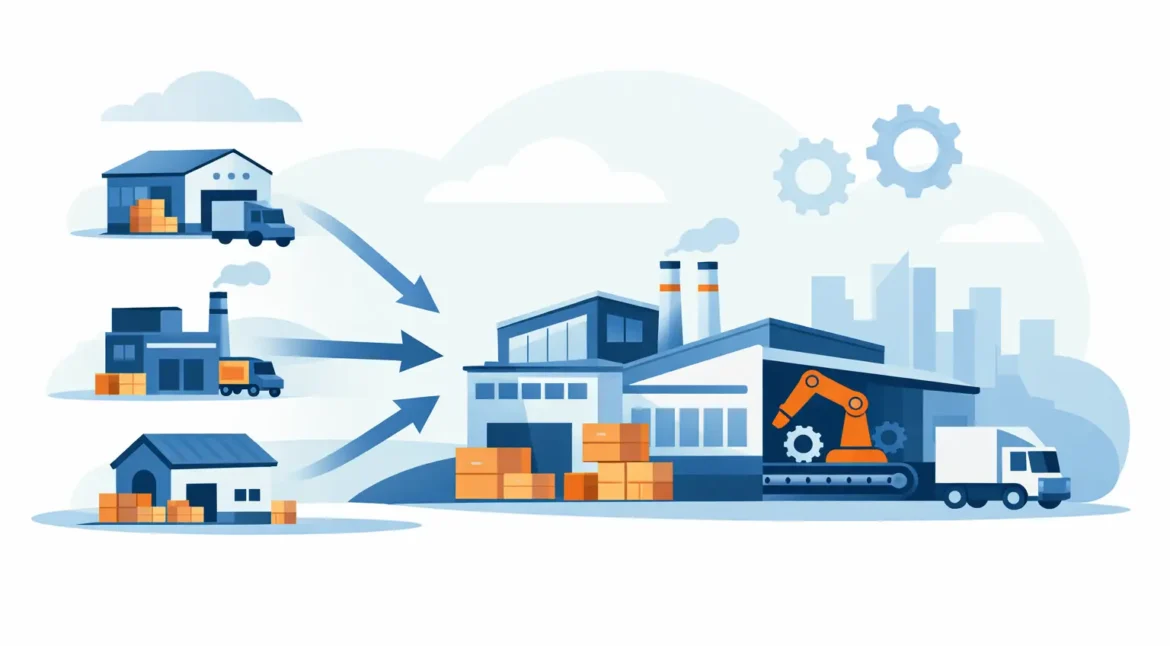
Every extra supplier in a manufacturing operation creates another point of friction – another quote to request, another shipment to track, another invoice to reconcile, another chance for production to wait on missing material. That is why supplier consolidation for manufacturing has become a practical cost-control strategy, not just a procurement exercise. For operations leaders under pressure to reduce spend and keep lines running, fewer suppliers often means fewer delays, clearer accountability, and better use of internal time.
That said, consolidation is not simply a matter of cutting a vendor list in half. Done well, it improves purchasing leverage, packaging consistency, freight coordination, and service response. Done poorly, it can create dependency, limit flexibility, and expose the plant to risk if one supplier underperforms. The real value comes from consolidating the right categories with the right partner under the right service structure.
Why supplier consolidation for manufacturing matters
Manufacturers rarely feel supplier sprawl all at once. It shows up in pieces. Packaging comes from one vendor, protective materials from another, specialty corrugated from a third, warehousing support from somewhere else, and freight is managed separately again. Each relationship may make sense on its own, but together they can create unnecessary complexity.
That complexity has a cost. Buyers spend more time managing transactions. Receiving teams deal with more partial deliveries. Operations teams work around inconsistent packaging specs. Finance processes more invoices. If a quality issue appears, accountability gets blurred because one supplier designed the packaging, another produced it, and a different carrier handled the shipment.
Consolidation helps by bringing more of those moving parts under one operational relationship. In many cases, the savings are not limited to unit price. They show up in reduced administrative work, fewer stockouts, tighter inventory planning, more reliable deliveries, and packaging designs that better support production speed and product protection.
For a plant manager or procurement lead, that distinction matters. A lower box price does not help much if poor coordination leads to downtime, expedited freight, or damaged product. Total operating cost is the real target.
Where consolidation delivers the strongest returns
Not every category should be consolidated in the same way, but packaging and related supply chain services are often strong candidates because they touch production, storage, and outbound delivery at the same time.
Corrugated cartons, die-cut boxes, partitions, pads, sheets, bakery boxes, meat boxes, and protective packaging are often purchased across multiple vendors over time. Sometimes that happens because of legacy relationships. Sometimes it is driven by short-term price shopping. Sometimes plants add suppliers as they grow, then never step back to rationalize the mix.
The result is usually inconsistent specifications, duplicate SKUs, and uneven service levels. One site orders one style of box, another orders a close variation, and both carry more inventory than necessary because lead times and minimums differ by supplier. Consolidation creates an opportunity to standardize where it makes sense, while still preserving custom packaging where production or product protection requires it.
There is also a freight advantage. When packaging supply, warehousing support, and transportation coordination are handled together, it becomes easier to schedule just-in-time deliveries, reduce emergency shipments, and align material flow with production demand. That kind of coordination can remove cost from the system without creating service risk.
What manufacturers often get wrong
A common mistake is treating supplier consolidation as a pure bidding event. Price matters, but if the selection process overlooks service range, engineering support, inventory planning, and delivery execution, the operation may trade a visible purchase price reduction for hidden downstream costs.
Another mistake is overconsolidating too quickly. It makes sense to streamline suppliers, but not all at once and not without clear performance controls. If one partner is going to handle a larger share of packaging, logistics, or inventory support, that partner needs the capacity, systems, and responsiveness to manage the broader role.
The third issue is failing to distinguish between commodity supply and operational support. A vendor that can sell boxes is not automatically equipped to improve packaging performance on the plant floor. Manufacturing environments need partners that can respond to schedule changes, engineer packaging around product requirements, support just-in-time replenishment, and help reduce freight and handling inefficiencies.
How to approach supplier consolidation without increasing risk
The best consolidation strategies start with data, not assumptions. Review what you buy, from whom, in what volumes, at what lead times, and with what service issues. Many businesses are surprised by how much duplication exists in packaging SKUs, freight arrangements, or supplier overlap across locations.
From there, evaluate suppliers against the outcomes that matter most to operations. Can they support multiple packaging categories? Can they provide design and package engineering input? Do they offer warehousing or cross-docking support if your storage space is tight? Can they coordinate transportation so packaging arrives when needed instead of too early or too late? Do they respond fast when demand shifts?
This is where it helps to think beyond a transactional supplier model. A strong consolidation partner should simplify purchasing while strengthening operational control. That may include standardizing product lines, redesigning packaging to reduce material use, improving cube efficiency, managing release schedules, and coordinating freight to reduce touches and delays.
It is also smart to phase the transition. Start with high-volume, high-friction categories where consolidation can produce quick improvements. Measure fill rates, on-time performance, quality consistency, inventory turns, and total delivered cost. Then expand the relationship based on performance, not promises.
The role of packaging in a broader consolidation strategy
Packaging is often underestimated in supplier consolidation discussions because it is viewed as a purchased material rather than an operational system. In practice, packaging affects labor efficiency, line speed, warehouse utilization, freight cost, and customer experience.
For example, a better corrugated design may reduce product damage and lower material use at the same time. A more consistent supply program may reduce floor congestion because deliveries are timed more precisely. Standardized packaging specs across facilities can simplify purchasing and improve training for plant teams. Those gains do not always show up in the item price, but they show up in operating performance.
That is why many manufacturers benefit from working with a partner that is not just a box company. When packaging sourcing is combined with engineering consultation, just-in-time delivery, warehousing support, and freight coordination, consolidation starts to produce compounding returns. Procurement gets fewer suppliers to manage. Operations gets more dependable material flow. Finance gets cleaner vendor management. Leadership gets better visibility into total cost.
When supplier consolidation is not the right move
There are cases where keeping multiple suppliers is still the better choice. Highly specialized materials, regional service constraints, customer-specific requirements, and contingency planning may justify a more diversified supplier base. Some manufacturers also prefer a secondary source for business continuity, especially in volatile markets.
That does not mean consolidation is off the table. It means the goal should be intentional consolidation rather than absolute consolidation. You may reduce ten suppliers to three, not three to one. You may consolidate standard packaging with one primary partner while maintaining backup sources for critical items. The right answer depends on your risk tolerance, plant footprint, and supply continuity needs.
What matters is that the supplier structure fits the operation instead of evolving by accident.
Choosing a partner for supplier consolidation for manufacturing
If you are evaluating partners, look for a provider that can support both product and process. Product capability matters – corrugated, protective packaging, custom formats, and specialty boxes all need to be covered. But process capability matters just as much. Can the supplier help manage inventory flow, reduce freight waste, respond to production changes, and solve packaging problems before they become line interruptions?
The strongest partners operate with a service mindset. They understand that time is money on the plant floor. They know that a late packaging delivery can stop production just as surely as a missing raw material. They are equipped to act quickly, communicate clearly, and take ownership when issues arise.
That is where a company like TEC Business Solutions fits best – as an operational partner that brings packaging supply, design support, warehousing, and freight coordination into one relationship built around lower total cost and dependable execution.
Supplier consolidation works when it removes complexity without removing control. The right move is not to chase the smallest vendor count. It is to build a supply structure that gives your team fewer problems to solve every day.