
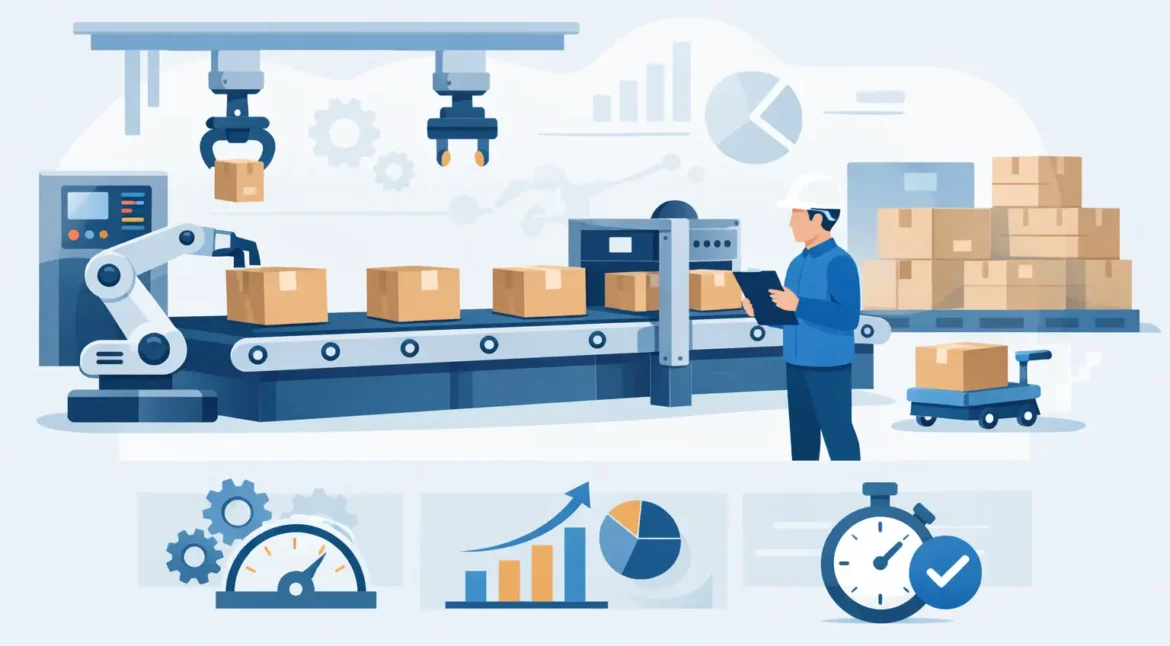
A packaging line rarely falls behind because of one dramatic failure. More often, output slips through small losses – a case size that does not run cleanly, changeovers that take too long, inconsistent materials, backup at the palletizer, or freight requirements that force workarounds upstream. That is why a guide to packaging line efficiency has to look beyond machine speed and into the full operating picture.
For manufacturers, food producers, and distribution-heavy businesses, line efficiency is not just a production metric. It affects labor cost, order fill rates, material spend, inventory levels, freight performance, and customer satisfaction. Time is money, and every avoidable stop on the line raises total operating cost.
What packaging line efficiency actually means
Packaging line efficiency is the ability to move product through packing, case forming, sealing, labeling, palletizing, and staging with minimal waste, minimal interruption, and consistent quality. A line can run fast and still be inefficient if scrap is high, labor is stretched, or damage shows up in transit.
That distinction matters because many companies focus on rated equipment speed while missing the real constraints. The line only performs as well as its weakest point. In some facilities, that is the pack station. In others, it is case erecting, material replenishment, warehouse flow, or the packaging itself.
A useful guide to packaging line efficiency starts with one question: where is the actual loss happening? Until that is clear, improvement efforts tend to chase symptoms instead of causes.
Start with the biggest sources of lost time
Most packaging lines lose efficiency in the same handful of places, but the mix differs by operation. Changeovers are a common problem, especially when multiple SKUs run through the same equipment. If operators need to adjust guides, swap materials, or compensate for packaging variation every time a product changes, available runtime shrinks quickly.
Material inconsistency is another frequent issue. Corrugated that varies in strength, dimensions, flute performance, or print quality can create jams, poor seals, stack instability, and rework. The line may appear to have a mechanical problem when the root issue is packaging that does not perform consistently under production conditions.
Then there is replenishment. A line that waits on cartons, partitions, film, labels, or pallets is not suffering from a machine problem. It is suffering from a support-flow problem. This is where operations and supply chain overlap. Just-in-time delivery, better staging, and cleaner inventory control can improve line performance as much as an equipment adjustment.
Labor allocation also deserves attention. If skilled operators spend too much time clearing jams, moving materials, or making manual corrections, efficiency drops and labor cost rises. In many plants, the fastest way to improve output is not hiring more people. It is removing the interruptions that keep current teams from staying on task.
Packaging design has a direct impact on throughput
Packaging is often treated as a purchasing category first and an operational tool second. That approach usually costs more over time. A cheaper box that runs poorly, requires more handling, or increases damage is rarely the lower-cost option.
Case dimensions, board grade, flute selection, die-cut accuracy, and closure design all influence line speed and reliability. If a carton is oversized, product movement inside the box can create damage and extra dunnage cost. If it is undersized or structurally weak, sealing problems and stack failures become more likely. If the board does not perform consistently, automated equipment has to work harder to compensate.
This is where package engineering matters. The right design should support machine performance, protect the product, and fit downstream requirements for storage and transportation. There are trade-offs. A heavier board may improve protection but increase material cost. A lighter design may save on corrugated but reduce pallet stability. The best answer depends on line conditions, product weight, stacking patterns, and shipping demands.
For operations leaders, the key is to evaluate packaging based on total cost to serve, not unit price alone. Not just a box company – the right partner helps connect packaging performance to labor, uptime, freight, and damage reduction.
Measure the line the way the business feels it
If the only metric on the board is units per hour, teams miss the broader cost picture. Good measurement should show where production is losing time, money, and consistency.
Start with a few numbers that matter operationally: unplanned downtime, changeover time, scrap rate, rework, labor hours per unit, and on-time material availability. Then connect those numbers to customer-facing results such as order accuracy, damage claims, and on-time shipment performance.
OEE can be helpful, but only if it is used honestly. A strong availability score does not mean much if excess labor is needed to keep the line running. Likewise, high performance during a short run does not tell you much about efficiency across an entire week of mixed production.
It also helps to break losses into categories. Mechanical stops, packaging-related interruptions, waiting on materials, operator adjustments, and downstream congestion should not be lumped together. Once those losses are visible, improvement work becomes more practical.
Reduce changeover drag before buying more equipment
Many plants consider capital investment before they have fully addressed setup loss. That can be expensive. If the line spends too much time between runs, throughput suffers even when equipment is technically capable.
The first step is standardization. Use packaging specs that are tight enough to run consistently across shifts and suppliers. Document setup settings clearly. Stage the next SKU before the current one ends. Where possible, reduce the number of packaging variations that require frequent machine adjustments.
The second step is to review whether packaging formats are creating unnecessary complexity. Multiple box sizes may make sense from a sales or product standpoint, but they can slow production if changeovers are constant. In some cases, rationalizing a packaging family can save more than negotiating a lower unit price on every SKU.
The trade-off is flexibility. Some businesses need a broad packaging mix because of retail requirements, product variety, or promotional runs. That is fine, but the operational cost should be measured and planned for rather than absorbed without visibility.
Fix support systems around the line
An efficient packaging line depends on more than packaging and machines. It depends on whether the surrounding support systems are built to keep production moving.
Warehousing, cross-docking, inbound scheduling, and replenishment discipline all affect uptime. If packaging materials arrive late, arrive in poor condition, or are stored in a way that creates damage before use, line performance suffers. If freight scheduling forces rushed production windows, the line may run in reactive mode instead of steady flow.
That is one reason many manufacturers benefit from supplier consolidation. When packaging sourcing, engineering support, inventory planning, and freight coordination are handled with one operating mindset, there are fewer handoff failures. A company like TEC Business Solutions can support that model by tying packaging supply, just-in-time delivery, warehousing support, and transportation coordination together instead of treating them as unrelated functions.
Where to focus first for the fastest return
If you are trying to improve efficiency quickly, start where the line loses repeatable time every day. That may be one machine center, one packaging SKU, one shift, or one material category. The goal is not to launch a plant-wide initiative before the facts are clear. The goal is to remove the most expensive friction first.
In many operations, the best early wins come from tightening packaging specifications, improving material consistency, shortening changeovers, and cleaning up replenishment flow. Those changes are less disruptive than major equipment projects and often produce visible gains in throughput and labor use.
That said, it depends on the operation. High-volume plants may gain more from automation and line balancing. Mixed-SKU environments may benefit more from packaging standardization and setup discipline. Food producers may need to weigh moisture exposure, cold-chain handling, and product protection more heavily than a dry-goods shipper would.
A practical way to think about line efficiency
The simplest way to improve a packaging line is to stop treating efficiency as a machine issue alone. Packaging performance, operator workflow, inventory support, and freight demands all show up on the line, whether they are measured there or not.
When the packaging is engineered for the application, materials arrive when needed, the line is set up for repeatability, and transportation requirements are considered early, output becomes more stable and total cost starts to fall. That is the real value of a guide to packaging line efficiency. Better line performance is not just about moving faster. It is about building an operation that runs with fewer interruptions and gives your team a better chance to stay ahead tomorrow than they had today.