
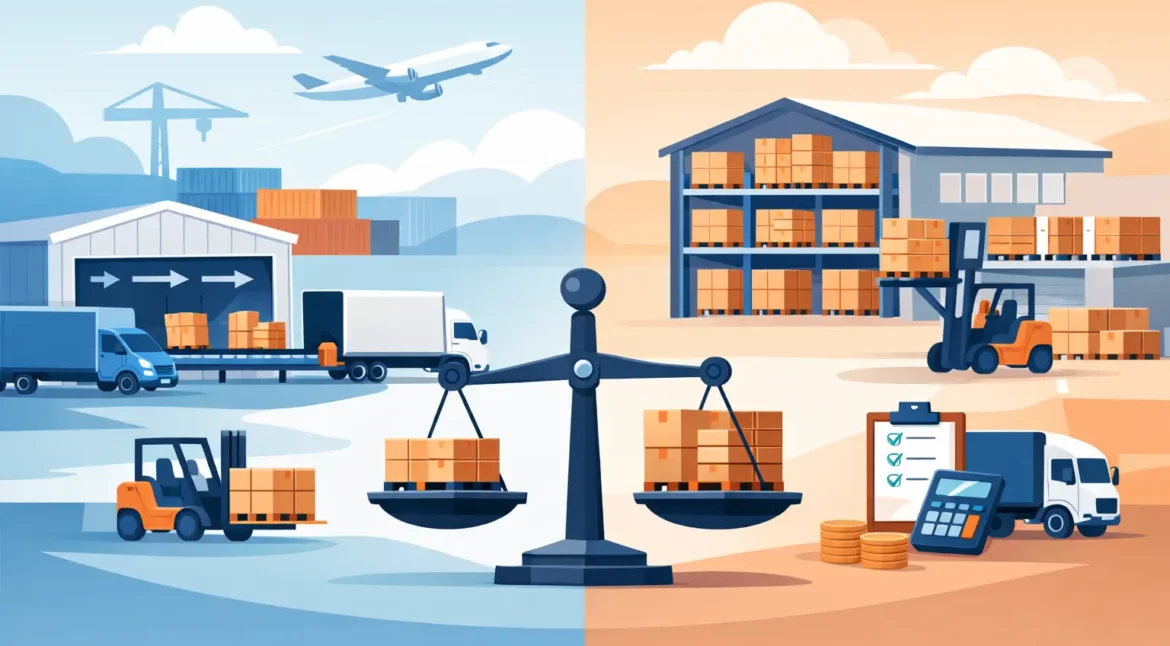
When a plant runs short on packaging, ingredients, or finished goods staging space, the cost problem usually shows up before the reporting does. Freight gets expedited. Labor starts chasing product. Trailers become temporary storage. That is where the real conversation around cross docking vs warehousing costs begins – not in theory, but on the floor, where delays and extra touches turn into margin loss.
For manufacturers, food producers, and distributors, the choice is rarely as simple as picking the cheaper line item. Warehousing and cross docking solve different operational problems, and the lower total cost depends on inventory flow, order timing, freight patterns, and service requirements. If you are evaluating which model fits your operation, the right question is not just what each option costs per pallet or per square foot. The right question is what each option costs your business once labor, speed, storage, inventory risk, and customer service are factored in.
Cross docking vs warehousing costs: the basic difference
Cross docking is built for movement. Product arrives at a facility, gets sorted or transferred, and moves back out quickly, often within hours and usually within a day. The goal is to reduce or eliminate storage time.
Warehousing is built for holding inventory. Product is received, stored, managed, picked, and shipped later based on production schedules or customer demand. It provides buffer stock, order flexibility, and supply continuity.
That difference matters because the cost structure is different from the start. Cross docking tends to lower storage expense and reduce carrying costs, but it often demands tighter scheduling, better visibility, and more coordinated transportation. Warehousing adds storage and inventory-related cost, but it can protect operations from supplier variability, demand swings, and production interruptions.
Where cross docking can cost less
Cross docking usually wins on cost when inventory moves fast and handling can stay simple. If inbound and outbound shipments line up well, product can pass through a facility with fewer touches, less time on the floor, and lower storage exposure.
The most obvious savings come from reduced occupancy costs. You are not paying to hold product for days or weeks, and you are not carrying as much working inventory. That can lower rent allocation, utilities, rack space demand, insurance, and inventory financing pressure.
Labor can also be lower, but only under the right conditions. If product arrives in predictable volumes and leaves in full pallets or preplanned loads, the labor involved is mostly unloading, sorting, staging, and reloading. That is very different from a warehouse environment where labor may include put-away, replenishment, cycle counting, picking, repacking, and inventory control.
Cross docking can also improve freight efficiency. Consolidating inbound shipments from multiple suppliers into optimized outbound loads often reduces empty space, partial truckload reliance, and stop-by-stop complexity. For businesses moving packaging materials, corrugated products, or production inputs on a just-in-time basis, that can translate into lower transportation cost per unit delivered.
There is another savings area that often gets overlooked: product risk. The less time goods sit, the lower the chance of damage, obsolescence, spoilage, or misplacement. That matters even more for food, seasonal items, short-run packaging, and materials tied to shifting production schedules.
Where warehousing can cost less
Warehousing can look more expensive at first because storage fees are visible. But for many operations, it is the more economical model once supply chain realities are taken into account.
If your demand is inconsistent, warehousing creates breathing room. That buffer can prevent line shutdowns, stockouts, and emergency replenishment. A warehouse gives you time to absorb supplier delays, transportation disruptions, and customer order changes without forcing the entire network into rush mode.
Warehousing also makes sense when order profiles are more complex. If product must be stored, picked in mixed quantities, repacked, or staged for different customers over time, a warehouse provides the systems and labor structure to do that accurately. Trying to force those requirements through a cross dock usually creates bottlenecks, rework, and premium freight.
There is also purchasing leverage to consider. In some categories, buying larger volumes and storing them lowers unit cost enough to offset the added storage expense. That is especially relevant when manufacturers want to lock in material pricing, avoid production interruptions, or consolidate inbound orders from multiple suppliers.
In other words, warehousing can be cheaper when it reduces volatility. If it prevents costly downtime, protects service levels, and allows better procurement timing, the total cost may be lower than a leaner but less forgiving cross-dock model.
The hidden costs that change the decision
Comparing cross docking vs warehousing costs only by facility rates leads to bad decisions. The true cost difference usually shows up in secondary expenses.
Scheduling discipline is one of the biggest variables. Cross docking depends on timing. If inbound loads arrive late, outbound loads wait. If outbound demand shifts, product may sit longer than planned and start behaving like warehouse inventory without the supporting structure. Poor appointment control can erase expected savings fast.
Inventory visibility is another factor. Cross docking works best when shipment status, order detail, and receiving accuracy are tight. If product shows up mislabeled, short, damaged, or without clear routing instructions, floor congestion and labor costs rise quickly.
Labor flexibility matters too. Warehouses carry more standing labor for inventory management, but cross docks often need fast response labor during concentrated shipping windows. Depending on your volume pattern, one model may create less labor waste than the other.
Then there is the cost of service failure. A warehouse may cost more to operate, but if it protects an assembly line or keeps customer shipments on time, it can save far more than it costs. Cross docking may reduce overhead, but if one late inbound shipment causes missed production or expedited outbound freight, the savings disappear.
How product type affects the cost equation
Not all freight behaves the same. Packaging materials, food products, industrial components, and retail-ready displays all create different cost pressures.
Standard, high-velocity SKUs are often strong cross-dock candidates because they move predictably and do not require much handling. Full pallets of corrugated cartons going directly to a production site can be ideal if timing is controlled and delivery windows are consistent.
Custom packaging, specialty components, or mixed-order shipments often fit warehousing better. If materials need to be staged by production run, held for release dates, or picked in varying quantities, storage becomes part of the service requirement, not just an added expense.
Perishable or shelf-sensitive product can go either way. Cross docking reduces dwell time, which is a clear advantage, but only if the transportation network is dependable. If variability is high, strategic warehousing may actually reduce spoilage by keeping inventory closer to end use and avoiding repeated disruptions.
When a blended model makes more sense
For many companies, the best answer is not either-or. It is a combination.
You may warehouse base inventory to protect supply continuity while using cross docking for fast-moving replenishment. You may hold custom or slower-moving packaging in storage while routing common items through a cross dock to reduce carrying costs. You may even use warehousing near production and cross docking to consolidate outbound freight.
That blended approach often delivers the lowest total cost because it matches the service model to the item, customer, or lane. Instead of forcing one logistics strategy across all products, it lets you protect operations where you need flexibility and strip out waste where you do not.
An integrated provider can make that model more practical by coordinating packaging supply, freight, and facility flow under one plan. That is especially valuable when packaging availability, transportation timing, and production schedules all affect each other.
Questions to ask before choosing
Before you decide between cross docking and warehousing, look closely at a few operational truths. How predictable is demand? How expensive is a stockout? How often do shipment schedules change? How much labor is tied to handling and rehandling product? Are you paying premium freight because material is in the wrong place at the wrong time?
Also look at the packaging and freight connection. If packaging arrives too early, it consumes space and working capital. If it arrives too late, production slows down. The right logistics model should support plant flow, not just lower one isolated budget line.
This is where experienced partners can add measurable value. A company like TEC Business Solutions looks at the full picture – packaging requirements, delivery cadence, storage pressure, freight coordination, and production support – because cost control rarely comes from one decision in isolation.
The better cost question
The real issue is not whether cross docking is cheaper than warehousing or vice versa. The better question is which model removes the most waste from your specific operation.
If your business runs on fast turns, consistent volumes, and tight delivery coordination, cross docking can cut storage, touches, and freight inefficiency. If your operation needs protection from variability, complex order handling, or inventory buffering, warehousing may be the smarter financial choice.
Time is money, but so is stability. The right answer is the one that keeps product moving, protects production, and lowers total operating cost without creating new problems somewhere else.