
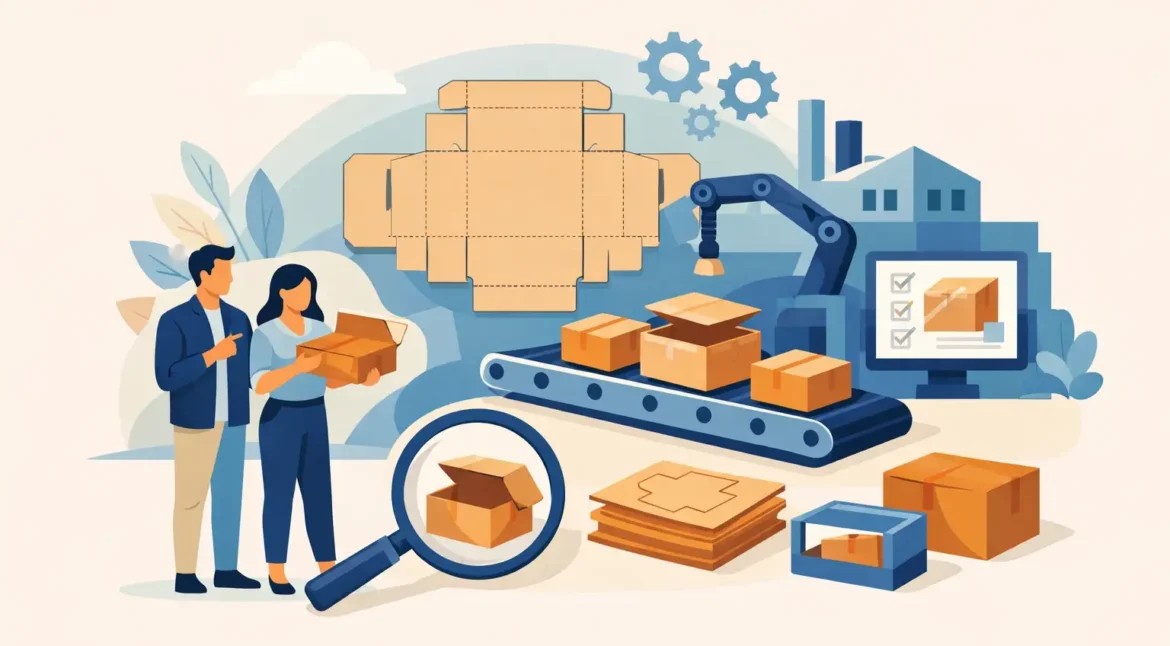
A bad-fitting box rarely fails in the conference room. It fails on the line, in the warehouse, or after a product shift damages freight. That is why choosing a die cut boxes manufacturer is not just a packaging decision. It is an operations decision that affects throughput, material cost, storage space, freight performance, and customer satisfaction.
Die-cut packaging is often the right answer when a standard regular slotted carton creates wasted space, weak product fit, or unnecessary material use. But the value of die-cut boxes depends heavily on who designs, produces, and delivers them. If the supplier only sells board and converting time, you may get a box. If the supplier understands production flow, transportation pressure, and inventory control, you get a packaging solution that works in the real world.
What a die cut boxes manufacturer should really provide
A die cut boxes manufacturer should do more than run a pattern through corrugated board. The right partner helps determine whether the design fits your product, your packing process, and your shipping conditions. That includes board selection, flute choice, structural performance, stacking strength, and the practical details that affect speed on the floor.
For manufacturers and distributors, the biggest issue is usually not whether a box can be made. It is whether the box can be made consistently, delivered on time, and used efficiently by your team. A package that looks right on a sample table can still create delays if it is hard to erect, difficult to load, or inconsistent from run to run.
This is where experience matters. A supplier with package engineering support can identify when a custom die line improves protection and when it only adds cost. Sometimes the best solution is a highly tailored die-cut design. Other times, a simpler structure with the right inserts or partitions gets the job done at a lower total cost.
Why die-cut boxes are used in industrial and food operations
Die-cut boxes are commonly selected when product dimensions are irregular, presentation matters, or standard cartons leave too much empty space. They are also useful when a package needs built-in locking features, display functionality, hand holes, internal retention, or a specific opening style for production or end use.
In food production, die-cut packaging may support product separation, ventilation, or efficient case packing. In industrial settings, it may reduce movement in transit, improve parts organization, or create a cleaner fit for heavier or awkward items. In both cases, the packaging has to perform under actual operating conditions, not ideal ones.
The trade-off is that die-cut solutions usually require more front-end design attention than commodity cartons. Tooling, setup, and order planning can be more involved. That does not make them expensive by default, but it does mean the supplier must know how to balance design benefits against lead time, inventory strategy, and run size.
How to evaluate a die cut boxes manufacturer
Price matters, but unit cost alone does not tell you much. A lower-price box that slows down packing or increases product damage can cost more than a better-designed option. Buyers who manage operations, procurement, or plant performance need to look at total impact.
Start with design capability. Can the manufacturer recommend board grades and flute profiles based on product weight, stacking, and transit conditions? Can they adjust the design to reduce material waste without sacrificing protection? If the answer is no, you may be buying a custom shape without getting custom value.
Next, look at manufacturing consistency. Die-cut boxes depend on accurate converting. Poor die maintenance, inconsistent scoring, or uneven board quality can create headaches fast. Boxes may crack during folding, fail to lock properly, or vary enough to disrupt packing speed. Consistency is especially critical when packaging is integrated into a repeatable production process.
Lead time and service responsiveness are just as important. Time is money, especially when packaging availability affects line scheduling. A dependable supplier should be able to support recurring demand, adjust to forecast changes, and communicate clearly when schedules shift. If your business runs lean inventory or seasonal spikes, that service level becomes even more important.
Warehousing and delivery options also deserve attention. For many operations, the best supplier is not the one that ships the biggest batch. It is the one that helps reduce storage burden while still keeping supply dependable. Just-in-time delivery, warehousing support, and coordinated freight can lower carrying costs and reduce the risk of production interruptions.
Design decisions that affect cost and performance
Not every custom box needs to be highly complex. In many cases, a good die cut boxes manufacturer will help simplify the structure so you are not paying for features you do not need. Small adjustments in dimensions, flute type, or closure style can change material usage, pallet efficiency, and packing speed.
Board selection is a major factor. Heavier board is not always better. Over-specifying the board can add cost, increase package weight, and reduce conversion efficiency. Under-specifying it can lead to crushing, product movement, or failures in stacking. The right recommendation depends on your product, environment, and shipping method.
Die-cut geometry matters too. A box designed around the exact product footprint can reduce void fill, improve cube utilization, and create more stable pallet patterns. That can translate into real savings in outbound freight and warehouse space. But if the design is too tight for easy loading or too intricate for fast assembly, the gains may disappear on the floor.
Printing and branding may also factor into the decision, though for many B2B buyers, operational performance comes first. If graphics are part of the package requirement, make sure they are handled in a way that does not compromise lead time or structural consistency.
Service matters as much as converting capacity
Many companies can manufacture corrugated packaging. Fewer can support it the way an operations team needs. When packaging is tied to production schedules, receiving windows, and customer deadlines, service becomes part of the product.
A strong supplier relationship should include practical problem solving. If your product changes, the packaging should adapt. If freight claims increase, the supplier should help investigate whether the structure, board, or pallet configuration needs revision. If volume grows, the supply model should scale without creating extra complexity.
This is why many buyers prefer a partner that can handle packaging and related logistics together. A box manufacturer focused only on production may meet spec but still leave you managing inventory swings, multiple vendors, and freight inefficiencies on your own. A broader service model helps connect packaging decisions to the full supply chain.
For companies looking to reduce total operating cost, that broader view is often where the real value shows up. Packaging design, sourcing power, delivery coordination, and manufacturing support work better when they are aligned. TEC Business Solutions approaches packaging this way because customers do not just need corrugated products. They need packaging that supports uptime, cost control, and reliable delivery.
Questions worth asking before you commit
Before selecting a supplier, ask how they approach testing and validation. Samples are useful, but real confidence comes from understanding how the package will perform under stacking, handling, and transit conditions. Ask how design changes are managed, what lead times look like after approval, and how inventory can be staged if your demand pattern changes.
It is also smart to ask how they respond when something goes wrong. Every supply chain hits issues at some point. The difference is whether your supplier reacts with urgency and ownership or pushes the problem back to your team. Responsiveness is not a soft metric. It directly affects downtime risk and customer service performance.
Finally, ask whether the supplier understands your operation well enough to recommend when die-cut packaging is the right fit and when it is not. That kind of honesty usually signals a better long-term partner. The goal is not to buy the most customized box possible. The goal is to use the right packaging to support production, protect the product, and keep total costs under control.
A die-cut box should earn its place in your operation. When the manufacturer behind it understands packaging, logistics, and plant realities, the result is not just a better box. It is a smoother day on the floor.

