
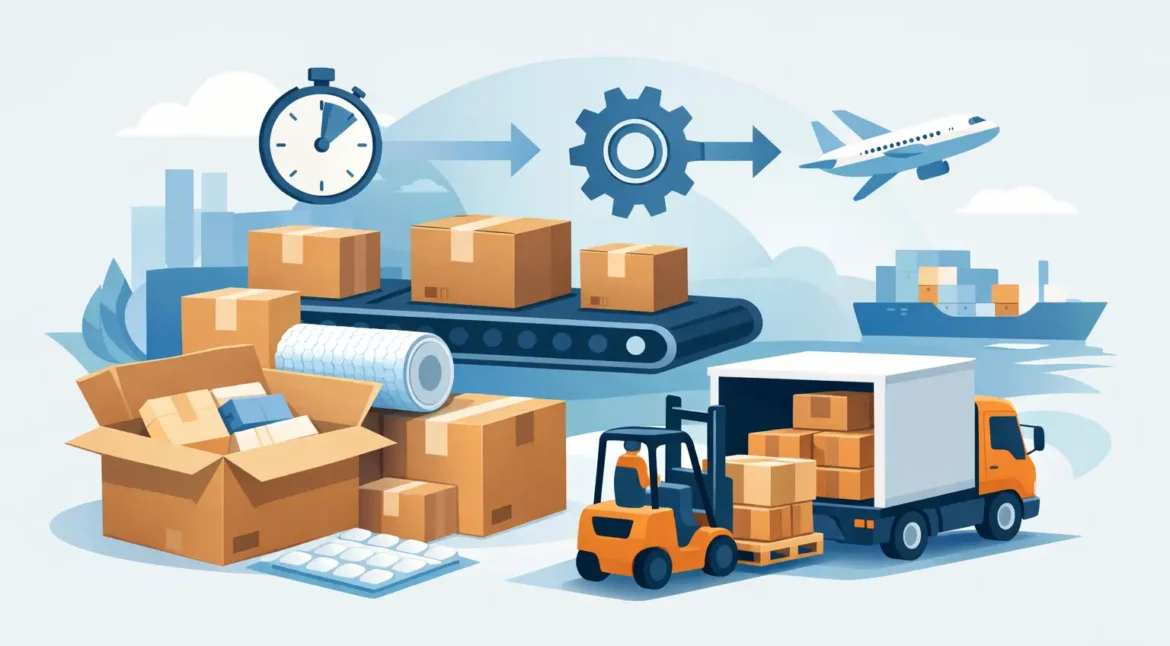
A truck leaves full, arrives on time, and unloads with no damaged product. That outcome usually starts long before the shipment hits the dock. Packaging design for shipping efficiency affects freight class, cube utilization, labor time, product protection, and how smoothly your operation moves from production to delivery.
For manufacturers, food producers, and distributors, this is not a design exercise for appearance alone. It is an operating decision. The right carton size, flute profile, protective packaging, pallet pattern, and load configuration can lower total cost across the supply chain. The wrong setup can quietly add cost at every step through wasted trailer space, slow packing lines, product loss, and avoidable freight claims.
What packaging design for shipping efficiency really means
Packaging design for shipping efficiency means building packaging around movement, storage, and delivery conditions, not just around the product itself. A box that protects a part in the warehouse may still perform poorly if it creates dead space on a pallet, requires excess filler, or slows down line packing.
Efficient shipping design balances several demands at once. It needs enough strength to protect the product, but not so much material that you pay to ship unnecessary weight. It needs dimensions that fit the item, but also dimensions that stack well on standard pallets and make better use of trailer space. It should support fast packing and consistent performance, especially in high-volume environments where delays compound quickly.
This is where many businesses miss the larger cost picture. Unit price matters, but total operating cost matters more. A lower-cost box is not really cheaper if it increases damage rates, labor time, or freight spend.
Start with product and transit realities
The best packaging decisions begin with a clear understanding of what the product is going through. Fragile components, food items, dense industrial parts, and irregularly shaped products all create different requirements. So do the conditions around them.
A shipment moving one state over on a predictable route is different from one crossing multiple touchpoints through parcel, LTL, or full truckload networks. Moisture exposure, compression risk, vibration, stacking height, temperature swings, and handling frequency all affect package performance. If those variables are ignored, companies often overpack to be safe or underpack and absorb losses later.
Package engineering works best when it accounts for actual distribution conditions. That includes how products are packed at the plant, how they are stored, how long they sit, and how many times they are handled before reaching the customer. In practice, shipping efficiency improves when packaging is designed for the full trip, not one isolated point in the process.
Right-sizing has a direct freight impact
One of the simplest ways to improve packaging design for shipping efficiency is right-sizing. Oversized boxes increase dimensional weight exposure in parcel shipping and waste cube in LTL and truckload moves. They also require more void fill, take up more warehouse space, and limit pallet density.
Right-sizing is not just about making the box smaller. It is about making it fit the product and the shipping method. A custom die-cut box or adjusted corrugated carton dimension can sometimes reduce air space enough to improve pallet count, lower transportation cost per unit, and reduce damage from shifting in transit.
There is a trade-off, though. If packaging is tightened too aggressively, it may slow down packing, make product insertion difficult, or reduce tolerance for product variation. The target is repeatable pack-out efficiency, not the smallest theoretical footprint.
Material selection affects both cost and performance
Corrugated choice has a major effect on shipping efficiency. Flute profile, board grade, wall construction, and coatings all influence compression strength, cushioning, weight, and printability. The most efficient option depends on what you are shipping and how it moves.
For some applications, a lighter board with better structural design can maintain protection while reducing material and freight weight. In other cases, especially with stacked loads or heavier products, stronger construction prevents collapse and avoids costly damage. Food and bakery packaging may also require material choices that account for moisture, hygiene, and temperature conditions.
This is where operational experience matters. Material reduction can create savings, but only if performance stays consistent in real-world conditions. Saving pennies on board while increasing claims, repacks, or rejected deliveries is not a win. The goal is to match the board and structure to the actual demands of the supply chain.
Pallet and trailer efficiency should shape the design
A box does not ship by itself. It ships as part of a pallet pattern, a warehouse slot, and a trailer plan. That is why packaging design should be evaluated at the load level, not only at the unit level.
Small dimensional changes can improve pallet utilization significantly. A footprint that aligns cleanly on a standard pallet reduces overhang, increases stack stability, and can raise cases per pallet. Better pallet density often means fewer loads, lower freight cost, and less handling.
Trailer utilization matters just as much. If package dimensions create inefficient stacking or leave unusable gaps, freight dollars are being spent on empty space. Businesses that ship high volume can see meaningful savings when packaging and freight planning work together. This is one reason companies benefit from treating packaging and transportation as connected decisions rather than separate purchasing categories.
Packaging design also affects labor and throughput
Time is money on the production floor. Packaging that looks acceptable on paper may create slowdowns if it is hard to erect, inconsistent on automated equipment, or difficult for operators to pack quickly.
Shipping efficiency improves when packaging supports line speed and reduces touches. That could mean easier-to-form corrugated cartons, partitions that speed product placement, pads that improve stability without extra handling, or protective packaging that is simpler to apply. In high-output plants, even small reductions in pack time per unit can produce major labor savings over a year.
There is often a balance between automation compatibility and packaging flexibility. Highly specialized designs may perform well for a stable product mix, but they can be less forgiving when SKUs change or seasonal demand shifts. The right answer depends on volume, production variability, and customer requirements.
Damage prevention is part of shipping efficiency
Freight cost gets attention because it is easy to measure. Damage cost is often more expensive and less visible. It shows up in returns, replacements, production interruptions, chargebacks, customer dissatisfaction, and time spent resolving claims.
Efficient shipping design reduces movement inside the package, supports stacking strength, and protects against the hazards of the chosen transportation mode. That may involve partitions, pads, custom inserts, protective packaging, or changes to carton construction. It may also involve rethinking palletization or stretch wrap patterns if the issue is load instability rather than box failure.
The lowest-cost packaging is rarely the packaging with the lowest purchase price. It is the packaging that gets the product to its destination intact while supporting efficient storage, handling, and freight usage.
Why integrated support changes the outcome
Many businesses buy packaging from one supplier, manage warehousing through another, and solve freight issues somewhere else. That separation makes it harder to optimize the whole system. Packaging decisions get made without full visibility into transportation constraints, inventory flow, or plant-level operating pressure.
A more effective approach is to evaluate packaging through an operational lens. That means looking at sourcing, package engineering, inventory management, just-in-time delivery, and freight coordination together. When those functions align, businesses can reduce packaging complexity, avoid stockouts, improve responsiveness, and control total landed cost more effectively.
This is where a partner with packaging and logistics experience can add measurable value. TEC Business Solutions works with customers across packaging supply, design support, warehousing, and freight coordination because these issues are connected in day-to-day operations. Better packaging decisions are stronger when they account for how the product is actually built, stored, shipped, and delivered.
Where to focus first
If you want to improve shipping efficiency, start by reviewing your highest-volume or highest-cost shipments. Look for signs of wasted cube, recurring damage, excessive filler, inefficient pallet patterns, or pack stations that slow down under volume. Those are usually the clearest opportunities.
Then compare packaging cost to total shipping and handling cost, not just unit price. A box redesign that trims trailer space, reduces labor, or cuts damage can outperform a cheaper carton very quickly. Testing matters here. Good packaging decisions should be validated in real operating conditions, especially when products are heavy, fragile, perishable, or moving through complex distribution channels.
The practical goal is not perfect packaging on paper. It is packaging that performs reliably in production, holds up in transit, and lowers total cost across the system.
The companies that gain the most from packaging design for shipping efficiency are usually the ones that stop treating packaging as a commodity. When packaging is designed as part of operations, it becomes a lever for better freight performance, faster throughput, and fewer costly surprises at delivery.