
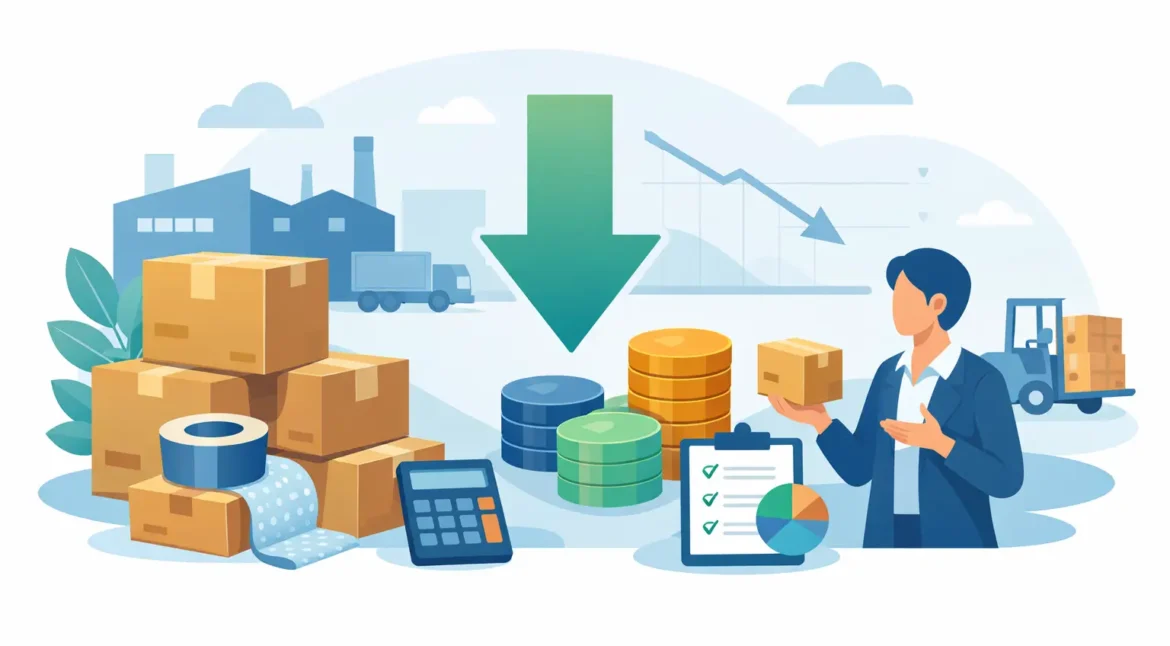
When packaging costs creep up, most companies look at the unit price first. That matters, but it is rarely the whole story. The fastest way to reduce packaging supply costs is to look beyond the box price and examine how packaging affects production speed, damage rates, storage, labor, and freight.
For manufacturers, food producers, and distributors, packaging is an operating input. If it slows the line, takes up too much warehouse space, arrives late, or creates freight inefficiencies, it costs more than the invoice suggests. The companies that control packaging spend most effectively treat packaging as part of a broader supply chain strategy, not a one-line commodity purchase.
Reduce packaging supply costs by focusing on total cost
A lower quote can be expensive if it creates problems elsewhere. A carton that is slightly cheaper but fails more often in transit can lead to returns, rework, chargebacks, and customer complaints. A package design that uses excess material may protect the product, but it can also increase dimensional weight, reduce pallet efficiency, and raise transportation costs.
That is why total cost matters more than piece price alone. Procurement teams may negotiate hard on unit cost, while operations teams absorb the hidden expense through downtime, overhandling, and wasted space. The better approach is to evaluate packaging across the full operating picture: material cost, packaging performance, line compatibility, inventory carrying cost, and freight impact.
This shift changes the conversation. Instead of asking, “Who has the cheapest box?” the better question is, “Which packaging setup lowers our total cost from receiving through delivery?”
Where packaging costs usually get out of control
In most facilities, overspending comes from a handful of common issues. One is over-specification. Many businesses keep using heavier board grades, extra inserts, or oversized cartons long after product requirements have changed. Another is supplier fragmentation, where multiple packaging vendors create inconsistent pricing, variable lead times, and more administrative work.
Inventory practices are another cost driver. Buying too much packaging to chase a price break can tie up cash and warehouse space. Buying too little can force rush orders, premium freight, and production disruption. Neither helps the bottom line.
Then there is packaging design drift. Over time, product lines change, customer requirements shift, and shipping patterns evolve, but the packaging often stays the same. What worked three years ago may now be more material than you need, or not enough protection for current distribution conditions.
Packaging design is one of the best ways to reduce packaging supply costs
Design changes often produce better savings than price negotiations alone. Small adjustments to dimensions, flute profile, board combination, partitions, pads, or die-cut construction can lower material use without sacrificing performance.
Right-sizing is a good place to start. If the carton is larger than necessary, you may be paying for extra corrugated material, more void fill, fewer units per pallet, and higher freight costs. A better fit can reduce packaging input and improve cube utilization at the same time.
Material optimization matters too. Not every application needs the same corrugated strength or structure. Some products require heavy-duty protection. Others can be packaged safely with a lighter, more efficient specification. The key is testing performance against actual handling conditions rather than assuming more material is always better.
There is a trade-off here. Cutting too far can create damage risk, especially in food distribution, industrial shipments, or multi-stop delivery networks. The goal is not the lightest possible package. It is the most efficient design that still performs consistently in production, storage, and transit.
Supplier strategy has a direct impact on cost control
If packaging procurement is spread across several vendors, it is hard to maintain pricing discipline and service consistency. Different lead times, freight terms, minimums, and quality standards create unnecessary variability. That variability usually shows up as hidden cost.
Consolidating with a capable packaging partner can improve pricing leverage, but the bigger advantage is operational control. When sourcing, package engineering, inventory support, and delivery coordination are aligned, companies spend less time managing exceptions and more time improving output.
This is especially important for businesses with multiple packaging types in use, such as corrugated cartons, bakery boxes, meat boxes, protective packaging, sheets, pads, and partitions. A single source that understands the broader packaging mix can spot overlaps, standardize specifications, and reduce complexity.
Not every business should consolidate everything with one supplier. If you have highly specialized packaging requirements or regional constraints, a blended model may make sense. But even then, fewer handoffs usually mean fewer cost leaks.
Inventory and delivery planning matter as much as purchase price
Time is money. Packaging that arrives late can stop production just as surely as a machine problem or material shortage. On the other hand, carrying too much packaging stock eats up space, labor, and working capital.
That is why inventory strategy matters. Just-in-time delivery can reduce on-site inventory and free warehouse capacity, especially for plants with limited floor space. Warehousing and cross-docking support can also help smooth supply without forcing large buys. The right approach depends on volume stability, lead-time risk, and how much disruption your operation can absorb.
There is no single formula. A steady, repeatable product line may support tighter replenishment schedules. A seasonal food producer or a manufacturer with volatile demand may need more buffer stock. The point is to match packaging inventory to actual operating conditions instead of letting price breaks drive buying behavior.
Freight is often the hidden packaging cost
Many companies separate packaging purchasing from freight planning, and that is where avoidable cost builds up. Packaging size, stackability, pallet pattern, and shipment density all affect transportation spend.
A package that looks efficient in isolation may be expensive on a truck. If cartons leave dead space on pallets, reduce trailer utilization, or require special handling, freight cost rises. The opposite is also true. Packaging engineered with shipping efficiency in mind can lower transportation cost without changing the product itself.
This is where coordination matters. When packaging decisions and freight decisions are made together, businesses can reduce total landed cost more effectively. That may mean changing carton dimensions, adjusting bundle counts, or redesigning a shipper to improve palletization. These are practical changes, not theoretical ones, and they often produce savings that do not show up in a standard box quote comparison.
Service reliability protects margins
The cheapest packaging program is not the one with the lowest initial price. It is the one that shows up on time, performs consistently, and supports production without surprises.
Late deliveries, quality variation, and inconsistent specs create expensive ripple effects. Purchasing has to expedite. Operations has to adjust. Customer service has to manage fallout if orders are delayed or damaged. Those costs rarely get assigned back to packaging, but they are real.
That is why responsiveness matters. A dependable supplier with strong service support can prevent premium freight, line interruptions, and emergency sourcing. For many product-based businesses, that reliability is worth more than a minor difference in unit price.
A practical way to reduce packaging supply costs
Start with a packaging review that looks at actual usage, not just what is listed in the system. Compare specifications across product lines, identify oversized or overbuilt items, and flag SKUs with recurring damage, handling, or storage issues. Then look at ordering patterns, minimums, and delivery schedules to see where inventory is helping and where it is simply sitting.
Next, review how packaging affects freight. Look at pallet efficiency, trailer fill, and any recurring premium transportation tied to packaging availability or poor fit. Finally, examine supplier overlap. If multiple vendors are serving similar needs, there may be opportunities to simplify sourcing and improve terms.
For businesses under pressure to lower costs without risking service, this is where an experienced partner can make a measurable difference. TEC Business Solutions supports companies that need more than a box supplier by combining packaging expertise, sourcing support, inventory coordination, and freight alignment into one operating solution.
The best savings usually do not come from squeezing one more cent out of a carton. They come from building a packaging program that works harder across your operation, every day.