
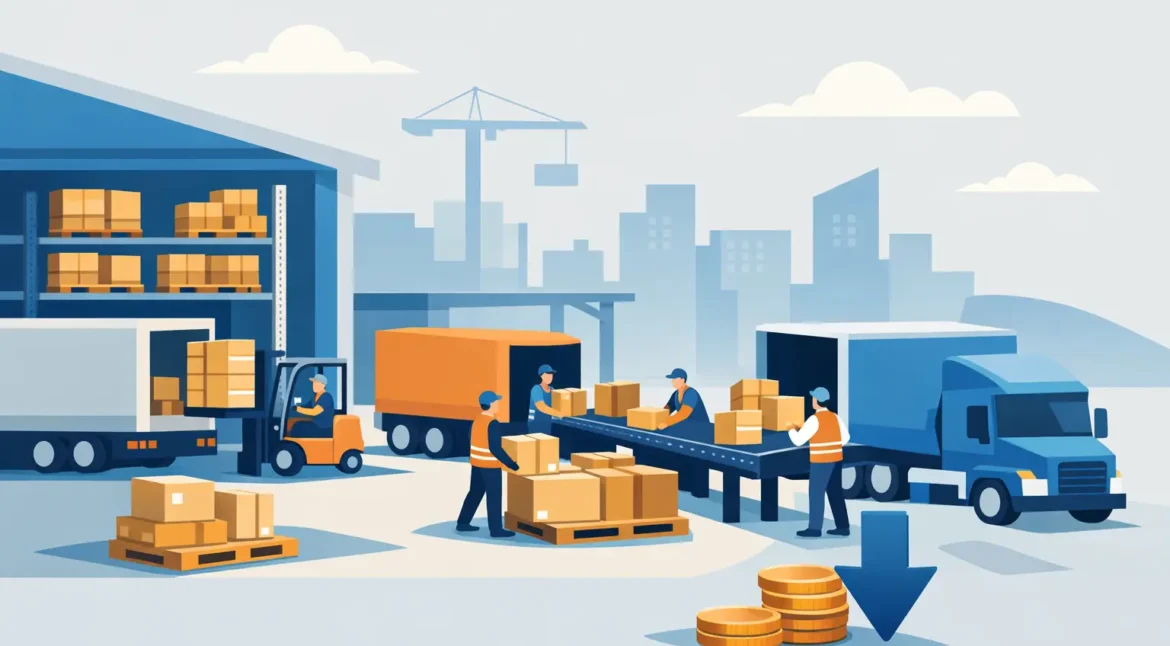
When a production line is waiting on packaging, pallets, or inbound components, every hour gets expensive fast. That is where warehousing and cross docking services earn their value – not as a back-office convenience, but as a direct way to protect uptime, reduce freight waste, and keep inventory moving at the pace your operation actually needs.
For manufacturers, food producers, distributors, and other product-based businesses, storage and transportation decisions affect more than space. They influence labor efficiency, order accuracy, material availability, and customer delivery performance. The right logistics setup can lower total operating cost. The wrong one can leave you paying for excess inventory, rushed shipments, and repeated handling that adds no value.
What warehousing and cross docking services actually do
Warehousing gives you controlled space to stage, store, and manage inventory before it is needed in production or shipped to a customer. Cross docking is different. Instead of putting product away for extended storage, incoming freight is received, sorted, consolidated, and moved back out quickly, often the same day or within a short window.
Both services support flow, but they solve different problems. Warehousing helps when demand patterns require buffer stock, scheduled release dates, or just-in-time delivery to multiple sites. Cross docking helps when speed matters more than storage and when reducing touches can lower cost and shrink lead time.
In practice, many operations need both. A plant may warehouse high-volume packaging materials for steady production while cross docking urgent inbound shipments, promotional displays, or mixed loads headed to regional customers. The point is not choosing one model forever. The point is using the right method for the product, the timing, and the freight profile.
Why manufacturers use warehousing and cross docking services
Time is money, but in manufacturing, timing is also margin. If packaging arrives too early, inventory carrying cost rises and valuable floor space disappears. If it arrives too late, production stalls and expediting starts. Warehousing and cross docking services help control that gap.
A well-run warehouse supports planned inventory availability. Materials can be held offsite and released based on production schedules, sales forecasts, or customer demand. That takes pressure off your facility and helps prevent stockouts without forcing you to overfill your plant with packaging or finished goods.
Cross docking serves a different kind of pressure. It is useful when shipments need to move through a node quickly, when less-than-truckload freight can be consolidated, or when multiple inbound items need to be sorted for immediate outbound delivery. Fewer storage days and fewer touches often mean lower handling cost and faster transit through the network.
That said, cross docking is not the right answer for every product. If inbound schedules are inconsistent, documentation is incomplete, or product requires inspection, repacking, or special staging, short-term storage may still be the better call. Good logistics planning is less about chasing a trend and more about matching service design to operational reality.
The cost side most companies miss
Many companies compare warehouse rates or freight quotes line by line, but that narrow view can hide the bigger cost picture. A lower storage rate does not mean much if receiving delays create production downtime. A cheaper shipment does not stay cheap if it arrives out of sequence and forces labor inefficiency at the plant.
The real value in warehousing and cross docking services comes from total cost control. That includes reduced emergency freight, lower on-site inventory burden, better trailer utilization, improved order sequencing, and fewer disruptions caused by late or fragmented deliveries. In some cases, consolidating packaging supply, freight coordination, and inventory staging under one provider removes enough friction to create savings across several departments at once.
This is especially true for businesses managing high packaging volume. Corrugated cartons, protective packaging, meat boxes, bakery packaging, pads, partitions, and specialty box styles all take space. If those materials can be engineered, sourced, staged, and delivered on a schedule that matches production use, the savings show up beyond purchasing. They show up in plant flow, labor planning, and freight efficiency.
When warehousing makes the most sense
Warehousing is usually the stronger option when your operation depends on predictable inventory access over time. That includes situations where packaging or components are purchased in larger runs for price advantage, but released in smaller quantities to support production. It also works well when your customer base has recurring demand but inconsistent order timing.
For many businesses, offsite warehousing creates room to operate. Production space stays focused on manufacturing, not storage. Inventory remains accessible without crowding the floor. Scheduled releases make it easier to align inbound material with production windows, especially when lead times are tight or internal storage is limited.
Warehousing also helps when quality consistency matters. If materials are sourced through one channel and staged under controlled handling processes, there is less risk of shortages caused by fragmented suppliers or poor inventory visibility. For operations leaders, that reliability is often worth more than shaving pennies off a per-unit quote.
When cross docking delivers the biggest advantage
Cross docking works best when speed and coordination matter more than holding inventory. If inbound product can be transferred directly to outbound moves with minimal delay, you reduce storage cost and shorten the path from supplier to destination.
This model can be effective for regional distribution, customer-specific order sorting, and freight consolidation. For example, multiple suppliers may send materials into one point, where shipments are combined and dispatched as fuller, more efficient outbound loads. That can reduce transportation cost per unit and improve delivery timing.
Cross docking can also support product launches, retail programs, or seasonal spikes where inventory needs to be repositioned quickly. Instead of warehousing everything for weeks, shipments move through as needed. But success depends on tight scheduling, clean data, and responsive communication. If appointments slip or labels are inaccurate, the benefit can disappear quickly.
Why integration matters more than space alone
Storage capacity is only one part of the equation. What matters more is how warehousing, packaging supply, and transportation work together. If those functions are managed separately, handoffs tend to create delays, duplicate communication, and avoidable cost.
An integrated partner can coordinate release schedules, packaging availability, inbound receipts, outbound freight, and special handling under one operating plan. That is where logistics becomes more than warehousing. It becomes a tool for keeping production supplied, reducing administrative burden, and improving delivery consistency.
For companies trying to simplify vendor management, this matters. Working with a provider that understands packaging requirements as well as freight flow can solve practical issues faster, whether that means staging custom corrugated, managing just-in-time releases, or routing outbound shipments to meet customer windows. TEC Business Solutions approaches this as an operational service, not just a storage transaction.
What to ask before choosing a provider
Not every provider is built for manufacturing environments. Before selecting a warehousing or cross docking partner, look beyond square footage and basic rate sheets. Ask how inventory is tracked, how release schedules are managed, how rush requests are handled, and how quickly the team responds when delivery plans change.
It also helps to understand where the provider adds flexibility. Can they support mixed packaging SKUs, customer-specific labeling, freight coordination, and scheduled replenishment? Do they understand production consequences if a shipment misses its window? The best providers do not just move product. They help you avoid downtime, excess inventory, and unnecessary complexity.
There should also be a clear discussion about fit. Some products require longer storage, lot control, or careful handling. Others are ideal for rapid transfer through a cross dock. A provider that is willing to say it depends, and then explain why, is usually more useful than one promising the same model for every operation.
A better way to think about logistics support
Warehousing and cross docking services are often treated as tactical line items, but for many businesses they should be viewed as production support tools. They influence how quickly materials reach the floor, how efficiently outbound orders are built, and how much working space your operation keeps available for value-producing activity.
If your current model leaves you carrying too much inventory, paying too much for freight, or reacting too often to shortages and schedule changes, the issue may not be product demand alone. It may be that your storage and transfer strategy no longer fits the way your business operates.
The right setup is the one that supports your pace, your freight mix, and your production risk. Sometimes that means warehousing. Sometimes it means cross docking. Often it means a combination built around your actual workflow, not a generic logistics package.
When logistics is planned with production in mind, you do not just move materials more efficiently. You create more control where it counts – on the plant floor, in the shipping schedule, and in the costs that quietly build up between purchase order and final delivery.