
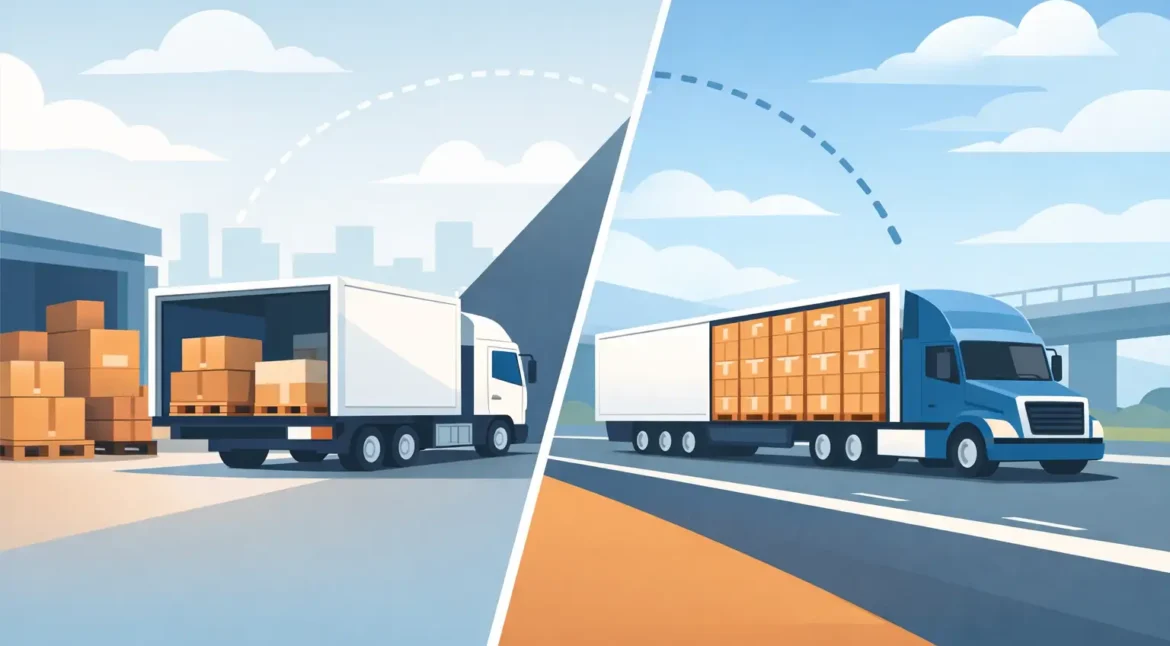
A late shipment does more than miss a dock appointment. It can slow production, tie up labor, delay customer orders, and raise your total landed cost. That is why the decision around ltl versus ftl freight matters well beyond transportation. For manufacturers, food producers, and product-based businesses, the right freight mode can protect margin, improve flow, and reduce avoidable disruption.
The question is not which option is better in every case. The real question is which option fits the shipment, the timeline, and the operating reality behind it. That answer often changes based on order volume, packaging configuration, delivery windows, and how costly a delay or damage claim would be.
Understanding ltl versus ftl freight
LTL stands for less-than-truckload. FTL stands for full truckload. The difference sounds simple, but the operational impact is significant.
With LTL, your shipment shares trailer space with freight from other shippers. You pay for the portion of the trailer you use, typically based on pallet count, weight, dimensions, freight class, and lane. This can be a smart option when you do not have enough volume to fill a truck and want to avoid paying for unused capacity.
With FTL, one shipment generally occupies the full trailer, or at least moves as a dedicated load. Even if the trailer is not packed wall to wall, the truck is assigned to that shipment rather than combined with multiple stops and multiple customers’ freight. That usually gives you more control over transit and handling.
For companies that move packaging, corrugated products, ingredients, finished goods, or industrial materials, this distinction can affect every step after order release.
When LTL makes sense
LTL is often the right fit when shipment volume is modest and cost control is the priority. If you are moving a few pallets of cartons to a plant, replacement packaging to a co-packer, or smaller replenishment orders to distribution points, LTL can keep transportation spend aligned with actual usage.
It is especially useful when demand is steady but not large enough to justify a dedicated trailer. Instead of holding orders until volume builds, companies can ship what they need and preserve cash flow and floor space. In some operations, that supports lean inventory practices and just-in-time replenishment.
LTL can also help when shipping patterns are fragmented. If multiple smaller orders are going to different locations, using LTL may be more practical than trying to combine everything into truckload moves that do not match the destination pattern.
The trade-off is that LTL freight usually involves more touchpoints. Freight may be picked up, transferred through terminals, sorted, reloaded, and delivered on a route with other stops. Every handoff adds time variability and a little more exposure to damage.
When FTL is the better call
FTL is usually the stronger option when speed, control, and reduced handling matter more than sharing trailer space. If your shipment is large, time-sensitive, high-value, fragile, or tied directly to production continuity, full truckload often lowers overall risk.
A dedicated truck generally means fewer stops, fewer transfers, and a more direct route. That matters when a late delivery can idle a production line or create missed customer commitments. Time is money, and the cost of downtime often outweighs the difference between LTL and FTL rates.
FTL also tends to be the better choice for freight that is difficult to handle in a shared network. Large corrugated loads, protective packaging, point-of-purchase displays, or custom packaging components may cube out a trailer before they weigh out. In those cases, truckload can be more efficient than trying to fit bulky freight into the LTL system.
For food and industrial businesses, FTL can also simplify chain-of-custody concerns. Fewer handling events can mean better product protection and fewer surprises at receiving.
Cost is more than the freight rate
Many buyers start with the linehaul quote, but the better decision usually comes from looking at total operating cost. LTL often has a lower upfront price for smaller shipments, but that is only part of the picture.
If an LTL shipment arrives a day late and forces expediting on the next order, the lower initial rate may not save anything. If the freight is damaged because it moved through several terminals, claims processing and replacement costs can erase the perceived advantage. If receiving delays create overtime or production changes, the transportation decision has already affected labor and throughput.
FTL may look more expensive on the quote sheet, but it can lower hidden costs when reliability is critical. The opposite can also be true. Paying for a dedicated trailer when the shipment could have moved economically through LTL may add unnecessary spend.
That is why mode selection should be tied to the real cost of delay, damage, storage, handling, and inventory exposure.
Transit time and service reliability
One of the clearest differences in ltl versus ftl freight is predictability. FTL usually offers tighter transit control because the truck is moving one primary shipment from pickup to delivery. Appointment coordination is generally simpler, and the chance of network-related delay is lower.
LTL transit can be dependable on established lanes, but it is still built around consolidation. Freight may move efficiently one week and face terminal congestion the next. Weather, dock delays, and rehandling can all affect performance.
That does not mean LTL is unreliable. It means the service model has more moving parts. If your operation can absorb a reasonable delivery window and the shipment is not highly sensitive, LTL can work well. If your operation cannot afford uncertainty, FTL often provides the safer path.
Packaging and product protection matter
Freight mode should never be separated from packaging design. Shared-network shipping places different demands on packaging than dedicated truckload. If your product is moving LTL, packaging may need to account for more compression, stacking, vibration, and handling frequency.
That is especially relevant for manufacturers shipping custom cartons, die-cut boxes, bakery packaging, meat boxes, sheets, pads, or partitioned products. Bulky items can shift, crush, or scuff more easily if they are not configured for the realities of the mode.
This is where integrated operational support matters. A shipment decision should align with packaging strength, pallet pattern, load stability, and delivery urgency. Companies that treat packaging and freight as separate decisions often miss savings on both sides.
How to choose the right mode for your operation
A practical way to decide is to start with four variables: shipment size, delivery urgency, product sensitivity, and the cost of failure.
If the shipment is small, flexible on timing, and not highly damage-sensitive, LTL is often the efficient choice. If the shipment is large, urgent, fragile, or tied to production continuity, FTL usually makes more sense.
Then look one level deeper. Ask how often you ship the lane, whether appointments are strict, whether the freight cubes out, and whether your receiving locations are easy or difficult to service. A shipment that looks like LTL on paper may actually perform better as truckload because of handling limitations or scheduling pressure.
This is also where experienced coordination helps. TEC Business Solutions supports customers who are trying to lower operating cost across packaging and transportation, not just chase the cheapest truck. That approach tends to produce better decisions because it reflects what the shipment is supposed to achieve, not just what the rate says.
Common mistakes in ltl versus ftl freight decisions
One common mistake is choosing LTL only because the shipment does not fill a trailer. Volume matters, but it is not the only factor. A half-full truckload can still be the right move if the freight is time-sensitive or vulnerable to damage.
Another mistake is defaulting to FTL for convenience without reviewing frequency, lane density, or order planning. If smaller, scheduled LTL shipments can support the same operation with less cost and no service risk, the extra truckload spend may not be justified.
A third mistake is ignoring packaging configuration. Poor palletization, weak load containment, or packaging that is not designed for the chosen mode can turn a manageable shipment into a claim.
The better approach is simple. Look at the shipment, the timeline, and the business consequence if something goes wrong. Then choose the mode that protects the full operation.
The best freight decision is not the one that looks cheapest in isolation. It is the one that keeps product moving, protects customer commitments, and supports the way your business actually runs. When ltl versus ftl freight is evaluated through that lens, the right answer becomes much clearer.